Critical Lifting & Rigging Safety Standards WPR Guide
Executive Technical Summary
Heavy lifting and rigging operations introduce severe mechanical, gravitational, and structural collapse hazards into industrial plant environments. This technical reference manual outlines mandatory compliance mandates under Saudi Aramco General Instruction GI 7.025, SABIC SHEM specifications, and ASME B30 standards. Work Permit Receivers (WPR) and Lifting Supervisors must execute comprehensive lift plans, verify crane ground bearing pressures, inspect certified rigging hardware, and enforce strict swing-radius barricades to prevent catastrophic dropped loads.
Join Saudi Arabia’s Premier Industrial Safety Network
Access verified WPR exam practice questions, Aramco/SABIC safety updates, and technical loss prevention resources on our official WhatsApp channel.
Regulatory Scope and Classification of Critical Lifting and Rigging Safety Standards WPR Guide
Lifting operations across hydrocarbon processing plants, refineries, and mega-project construction sites are strictly categorized based on weight, complexity, and proximity to active process equipment. Under Saudi Aramco General Instruction GI 7.025 and SABIC SHEM standards, lifts are classified into three primary tiers: Routine Lifts, Critical Lifts, and Pre-Engineered Special Lifts.
A lift is officially designated as a Critical Lift if it meets any of the following operational parameters: lifting loads exceeding 75% of the crane’s rated capacity chart, operating two or more cranes simultaneously (tandem lift), lifting personnel in approved man-baskets, lifting over active hydrocarbon process lines, or handling loads with extreme wind exposure or eccentric centers of gravity. Work Permit Receivers (WPR) must verify that a formal, engineered Critical Lift Plan is approved by a certified Lifting Engineer before issuing permits.
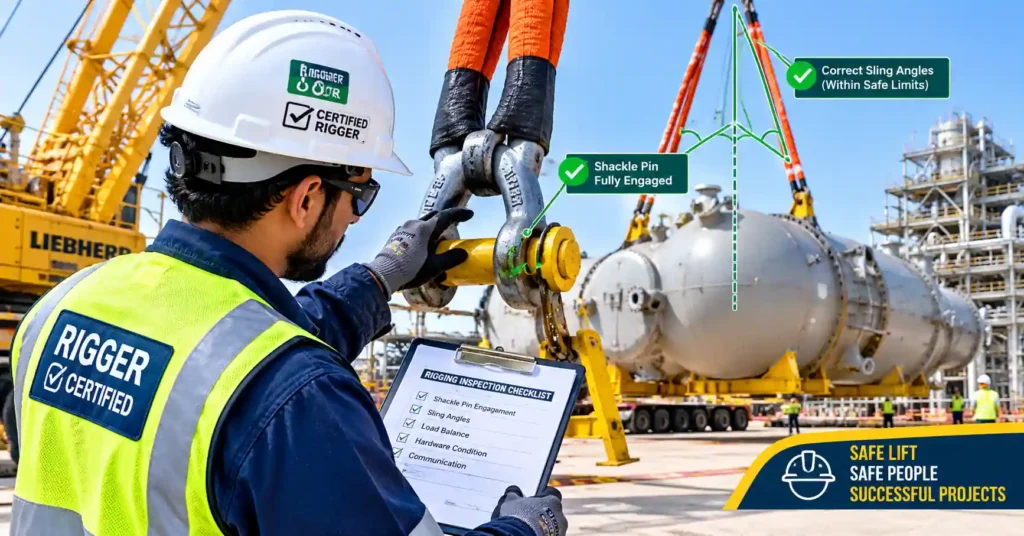 A certified rigger checks shackle pin engagement, sling connections, and rigging equipment before a heavy vessel lift.
Engineering Analysis of Crane Load Charts and Stability Calculations
Reading mobile crane load charts accurately is a core technical requirement for Work Permit Receivers and Lifting Supervisors. Overloading a crane or miscalculating operational radii leads directly to boom structural failure or machine overturning. Load chart capacity is determined by two distinct engineering limits: tipping capacity (stability limit) and structural capacity (strength limit of crane components).
When calculating total crane load under Saudi Aramco GI 7.025, the weight of the physical payload alone is insufficient. The total deducted capacity includes:
- Weight of the main hook block and overhaul ball.
- Weight of all rigging hardware including slings, shackles, spreader beams, and equalizer beams.
- Weight of the active wire hoist rope hanging from the boom tip.
- Weight allowance for effective jib extensions, whether stowed or erected.
The operational radius is measured horizontally from the center of rotation of the crane upper-works to the center of gravity of the suspended load. If the boom deflects under load, the radius increases automatically. Work Permit Receivers must verify that boom length, boom angle, and gross load fall safely within the manufacturer’s net capacity envelope before authorizing movement.
Ground Bearing Pressure Verification and Soil Conditions
Outrigger ground failure remains a leading root cause of mobile crane accidents in coastal and desert plant environments. Mobile crane outriggers exert concentrated point loads onto soil foundations that often exceed the unconfined compressive strength of undisturbed or backfilled ground.
- Outrigger Extension: Outriggers must be extended 100% to their fully pinned positions unless the manufacturer load chart explicitly provides partial-extension rating tables. Tires must be completely raised clear of ground contact to transfer full machine weight to outrigger beams.
- Matting and Blocking Area: Outrigger floats must rest on engineered steel plates or hardwood timber mats. Mat area must be calculated by dividing the maximum outrigger reaction force by the allowable soil bearing capacity:
- Required Mat Area Formula: Required mat area = Maximum outrigger load ÷ Allowable soil bearing pressure A = P / q Where: A = Required mat bearing area (m²)p P = Maximum outrigger load (kN) q = Allowable soil bearing pressure (kN/m²)
A{mat} = \frac{P{max}{q{allowable}
where P{max} is the peak outrigger load and {Qallowable} is the certified ground bearing capacity.
- Proximity to Subsurface Hazards: Cranes must not be positioned near underground piping trenches, electrical duct banks, or vessel foundations without written soil compaction verification from a geotechnical engineer. A minimum 1:1 slope clearance ratio must be maintained from the edge of open excavations.
[My Shutdown Experience:
During my last shutdown at the Arrazi (SABIC) plant, I witnessed a critical lifting operation during the night shift. Two cranes were involved in unloading large tubs using a tandem lifting arrangement. Because two cranes were working together to handle the load, proper coordination, valid documentation, and strict control of the lifting area were essential.
As part of our responsibilities as WPR and Safety personnel, we made sure that the required safety arrangements were checked before the lifting activity proceeded. We verified that the work permit was valid and that the approved lifting plan was available at the site. The lifting area was barricaded, warning signs were installed, and access was restricted to authorized personnel to keep other workers away from the operation.
We also checked that the crane operators and riggers were trained, competent, and properly certified for their assigned duties. The cranes and relevant lifting accessories had to have valid third-party inspection certificates, including TUV certification where applicable, along with the required inspection records. Slings, shackles, hooks, and other lifting tools needed to be inspected and in good condition before use.
Another important point was maintaining communication and coordination between both crane operators, the rigging team, and the lifting supervisor. During tandem lifting, both cranes must operate according to the approved lifting plan, with clearly defined responsibilities and reliable communication. The load must remain under control, and the team must not make unauthorized changes to the lifting arrangement.
We also ensured that the required fire watch was on standby where specified by the permit and site risk assessment. Gas testing and monitoring were carried out according to the permit issuer’s requirements and the specified testing frequency, where applicable. Good housekeeping, suitable lighting for night work, clear access routes, and the availability of inspected equipment were also important parts of preparing the work area.
From this shutdown experience, I learned that critical lifting safety is not just about having two cranes, certified operators, and a lifting plan. The real responsibility is to verify that the documents, equipment, work area, and people are all ready before the job starts—and to keep monitoring conditions throughout the operation.
As a WPR or Safety Officer, we must never hesitate to stop the job if an unsafe condition develops, communication fails, the load behaves unexpectedly, or the actual site conditions differ from the approved lifting plan. In a tandem lift, even a small mistake in coordination or load distribution can have serious consequences. Proper planning, continuous supervision, and teamwork are essential to completing the job safely..]
Mandatory Pre-Lift Inspection and Rigging Hardware Standards
Failure of rigging gear such as wire rope slings, synthetic web slings, alloy steel chain slings, shackles, and eyebolts accounts for a significant share of lifting accidents. Every component must feature legible manufacturer load ratings, traceability stamps, and valid third-party inspection color-coding.
- Wire Rope Inspection: Inspect for broken wires (maximum 10 distributed broken wires in one rope lay or 5 broken wires in one strand in one lay), severe kinking, bird-caging, core protrusion, main strand displacement, or heat damage. Retire damaged wire rope from service immediately.
- Synthetic Web Slings: Check for acid or caustic burns, melting or charring of any part of the surface, holes, tears, cuts, snags, broken stitches, or missing legible capacity identification tags. Synthetic slings must be protected from sharp metal edges using heavy-duty corner guards or softeners.
- Shackle and Hook Verification: Ensure forged alloy steel shackles (Grade 8) are stamped with working load limits (WLL) and manufacturer marks. Screw pins must be fully seated and tightened. Modifying shackle pins with makeshift bolts or re-threading is strictly prohibited. Check safety latch integrity on all crane hooks; spring latches must snap securely closed to prevent sling detaching.
- Sling Tension Calculation and Safe Sling Angles:
The tension in each sling leg increases as the sling angle decreases. For a symmetrical lifting arrangement with equal load sharing, the theoretical tension can be calculated using:
T = W / (N × sin θ)
Where:
– T = Tension in each sling leg
– W = Total supported load, including applicable rigging weight
– N = Number of sling legs assumed to share the load equally
– θ = Sling angle measured from the horizontal
Important safety note: A sling angle of 60° above the horizontal is generally preferred where practical because it reduces sling tension compared with lower angles. The applicable minimum angle must be confirmed from the current site lifting standard, approved lifting plan, and manufacturer’s requirements. Do not assume that a sling angle is acceptable based on this formula alone.
The lifting team must verify sling capacity, actual load distribution, lifting-point strength, shackle ratings, and the complete rigging arrangement before lifting. For multi-leg slings, equal load sharing must not be assumed unless justified by the lifting design. Critical and tandem lifts require assessment by the competent lifting personnel under the approved plan.
Comparison Matrix: Routine vs. Critical Lift Operational Requirements
Understanding the strict regulatory differences between routine and critical lifts is vital for WPR compliance under Saudi Aramco GI 7.025 and SABIC SHEM guidelines.
| Lift Parameter | Routine Lift Operations | Critical Lift Operations | Governing Standard |
|---|---|---|---|
| Capacity Utilization | Under 50% to 75% of crane chart | Exceeding 75% of crane rated capacity | GI 7.025 Section 5 |
| Engineering Approval | Standard checklist by certified rigger/WPR | Formal engineered Critical Lift Plan signed by specialist | ASME B30.5 / Aramco |
| Personnel Requirement | Certified Operator, Rigger-I/II, Signalman | Dedicated Lifting Supervisor, Rigger-I, Safety Officer | Mandatory on-site briefing |
| Environmental Limits | Standard operational wind monitoring | Strict wind speed cutoff (typically max 32 km/h / 20 mph) | Anemometer verified |
Technical Safety Highlight
Never ride on loads, hooks, or slings under any circumstances. Tag lines must be attached to all suspended loads to control rotation and prevent structural contact, but personnel must never wrap tag lines around their hands, limbs, or bodies.
Communication, Signaling, and Swing Radius Barricades
Clear, standardized signaling is mandatory during blind or obstructed lifts. Only one certified rigger or signalman shall communicate with the crane operator at a time, utilizing standard ASME B30.5 hand signals or two-way radios operating on a dedicated, interference-free frequency channel. An emergency stop signal may be given by anyone on the site, and the operator must obey it instantly.
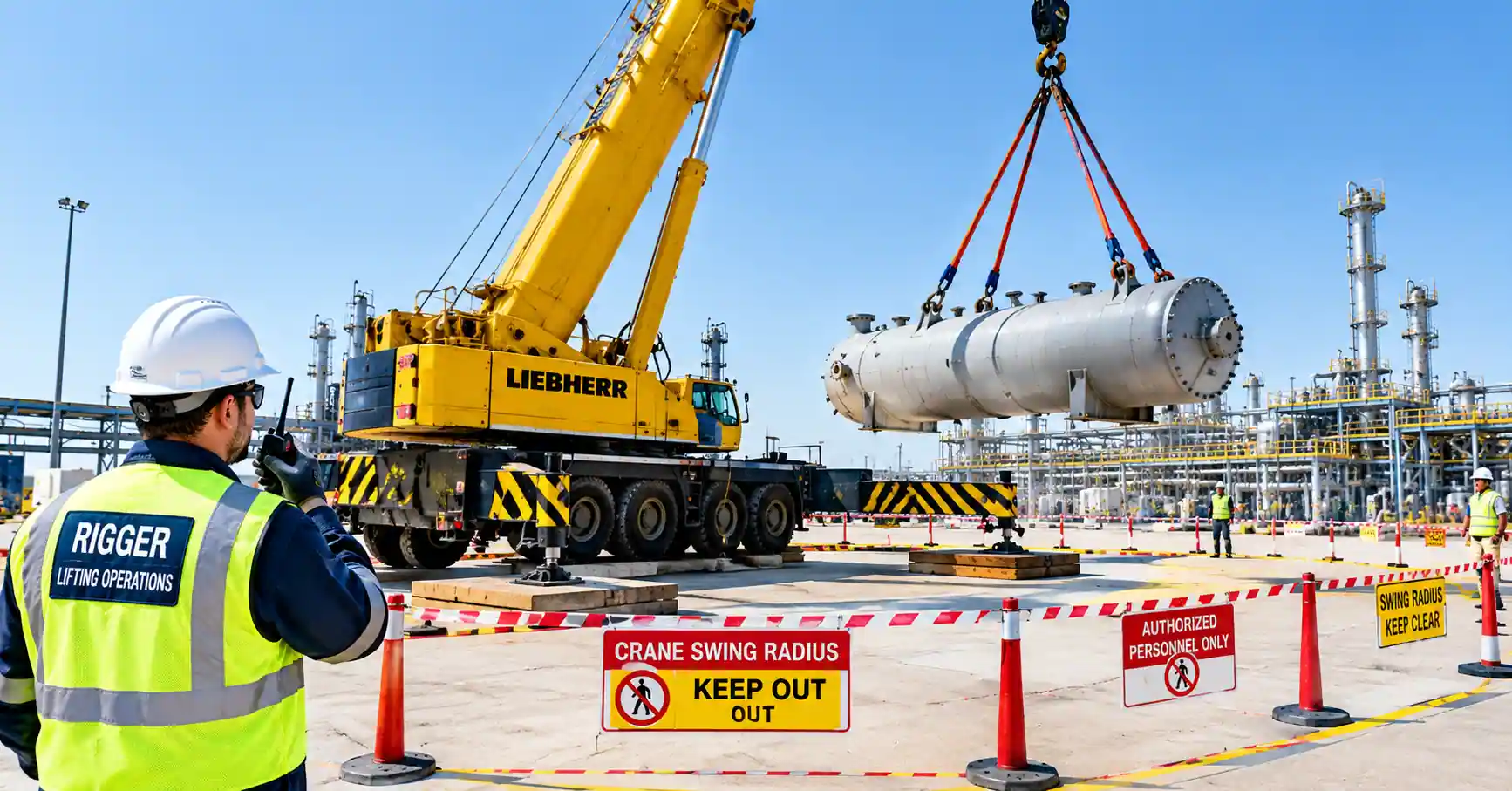
Furthermore, physical barricades must be established around the entire swing radius of the crane counterweight and boom. Unauthorized personnel are strictly prohibited from entering the fall zone or swing path while the load is suspended.
Scenario Based WPR Examination Practice MCQs
Test your knowledge for Saudi Aramco and SABIC Work Permit Receiver certification assessments with these field scenario questions:
Q1: A crane is scheduled to lift a 20-ton reactor vessel, which equals 82% of the mobile crane’s maximum capacity chart at the target radius. How must this operation be classified under Saudi Aramco GI 7.025?
- A) Routine Lift requiring a standard equipment checklist only.
- B) Critical Lift requiring a formal engineered lift plan and special management approval.
- C) Pre engineered standard lift exempt from safety review.
- D) Tandem lift requiring a second backup crane.
Correct Answer: B
Engineering Rationale: Any lift exceeding 75% of the crane’s rated capacity chart is legally classified as a Critical Lift under GI 7.025, demanding an approved critical lift plan, rigorous rigging inspection, and continuous oversight.
Q2: During a heavy lift operation, wind speeds begin gusting above 35 km/h, exceeding the threshold specified in the lift plan. What is the mandatory action required by the Work Permit Receiver and Lifting Supervisor?
- A) Continue lifting at a slower crane hoist speed.
- B) Immediately halt the lifting operation, set the load down securely, and suspend work until wind speeds subside.
- C) Remove the rigging crew from the area while keeping the load suspended in mid-air.
- D) Double the number of tag lines attached to the load.
Correct Answer: B
Engineering Rationale: Exceeding weather and wind velocity limits specified in the lift plan creates severe load sway and loss of crane stability. Work must stop immediately and the load must be landed safely.
Q3: A multi leg sling assembly is being rigged at a 30 degree horizontal sling angle. What is the primary safety concern associated with this configuration?
- A) The load will rotate uncontrollably without tag lines.
- B) The tension in each sling leg increases dramatically, exceeding rated capacity and risking leg failure.
- C) The crane outriggers will lose ground contact.
- D) The hook safety latch will unseat automatically.
Correct Answer: B
Engineering Rationale: At low horizontal sling angles (below 45 degrees), leg tension increases rapidly due to trigonometric multiplication forces. Saudi Aramco standards prohibit sling angles below 45 degrees to prevent mechanical overload.
Essential Industrial Safety Resources
Enhance your technical safety compliance expertise across all site disciplines:
- Review overall WPR examination criteria in our Saudi Aramco WPR Exam 2026 Guide.
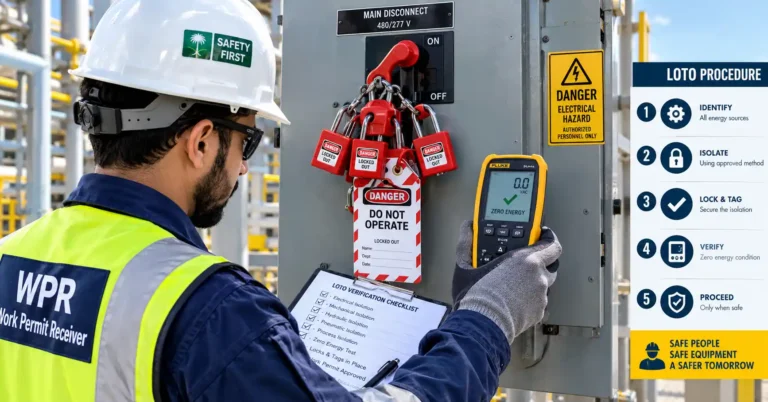
- Master hazardous energy isolation protocols in our Lockout/Tagout (LOTO) Procedures Guide.
What standard governs mobile crane safety in Saudi Aramco facilities?
Saudi Aramco General Instruction GI 7.025 (Crane Operating Safety and Rigging Requirements) is the primary governing standard for all lifting operations across Aramco and contractor sites.
When is a lift officially classified as a Critical Lift?
A lift is classified as critical when it exceeds 75% of the crane’s rated capacity chart, involves tandem/multiple cranes, lifts personnel in baskets, or handles loads directly over critical process equipment.
Why are outrigger mat foundations critical on industrial soil?
Outrigger mats distribute heavy concentrated point loads from crane outrigger floats across a wider surface area, preventing soil shear failure, outrigger sinking, and catastrophic crane tipping.
How many signalmen are allowed to communicate with a crane operator during a lift?
Only one designated, certified rigger or signalman shall communicate with the crane operator at any given time to avoid conflicting directions and operational confusion.
Author Engineering Credentials & Technical Governance
Lead Author: Senior Technical Safety Engineer & Industrial Loss Prevention Consultant holding over 15 years of operational expertise in oil, gas, and petrochemical complexes across Eastern Province, Saudi Arabia (Saudi Aramco facilities, SABIC Petrokemya, Hadeed, Sharq, Arrazi, and Yanpet).
Governing Industrial Standards & Codes Referenced:
- Saudi Aramco General Instruction GI 7.025 (Crane Operating Safety and Rigging Requirements)
- SABIC Environment, Health, Safety, and Security Standard SHEM-09 (Lifting and Rigging Safety)
- ASME B30.5 (Mobile and Locomotive Cranes Safety Standard)
- ASME B30.9 (Slings Safety Standards for Rigging Hardware)
- US OSHA 29 CFR 1926.1400 (Cranes and Derricks in Construction)