Saudi Aramco WPR Exam Questions and Answers 2026
Quick Exam Summary & Fast Track Checklist
- Core Governance: Saudi Aramco GI 2.100 Work Permit System.
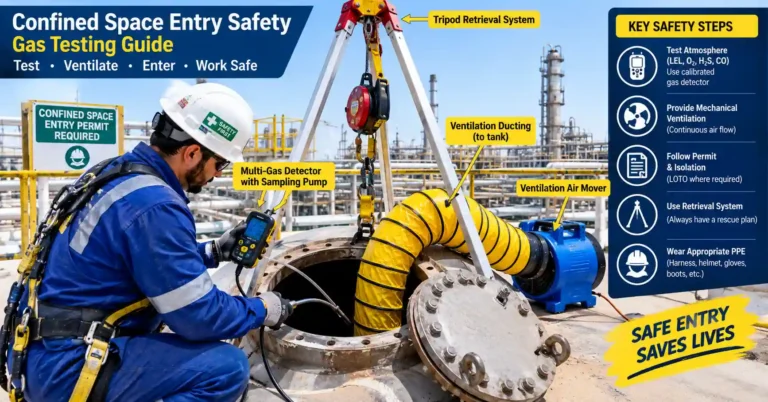
- Gas Limits: Know the applicable LEL, O₂, H₂S and CO limits and the required action for each reading.
- ( Note: LEL, H₂S, and CO should preferably be 0 ppm/0% where practicable. Any reading at or above the applicable alarm/action level requires appropriate action according to the site/Aramco procedure.)
- Permit Validity: Understand the applicable operational-shift, renewal and extension requirements.
- Joint Site Inspection: Issuer and Receiver participate in the required site inspection before permit issuance.
- Key WPR Duties: Verify permit conditions, isolation, gas testing, hazards and required controls before and during work.
- Stop-Work Awareness: Know when changing site conditions, alarms or uncontrolled hazards require work to be stopped and the permit reviewed.
Saudi Aramco WPR Exam Questions, Answers and Preparation
Preparing for the Saudi Aramco Work Permit Receiver (WPR) certification exam requires a thorough understanding of industrial safety standards, General Instruction (GI) manuals, and hazard recognition protocols. Whether you are a site supervisor, safety inspector, or job site receiver, obtaining an official Aramco Work Permit Receiver card validates your competency to issue, accept, and monitor hazardous work activities across onshore and offshore facilities.
This comprehensive 2026 preparation guide covers core Aramco safety standards, real-world scenario exam questions, critical gas testing thresholds, and practical field guidelines designed to help you pass the certification test on your first attempt.
What is a Saudi Aramco Work Permit Receiver (WPR)?
A Work Permit Receiver is a certified individual authorized by Saudi Aramco to request, receive, and maintain work permits at a specific job site. The receiver works alongside the Work Permit Issuer (typically an Aramco operations representative) to ensure that all safety controls, isolation procedures, and hazard mitigations are actively enforced before and during hot work, cold work, confined space entry, or equipment opening operations.
Core Responsibilities of a Certified WPR
- Joint Site Inspection: Walk the physical job site with the Issuer prior to signing the permit to verify that isolation, gas testing, and hazard controls are in place.
- Scope Adherence: Ensure that work is strictly confined to the specific equipment, location, and timeframe listed on the approved permit.
- Continuous Gas Monitoring: Perform or monitor continuous atmospheric tests when working in hydrocarbon-bearing or oxygen-deficient environments.
- Stop Work Authority: Immediately suspend work and recall permits if site conditions change, alarms sound, or unexpected hazards emerge.
Understanding Saudi Aramco General Instruction (GI 2.100)
All work permit operations within Saudi Aramco facilities are governed by GI 2.100 (Work Permit System). The primary objective of GI 2.100 is to establish standardized controls for high-risk work activities.
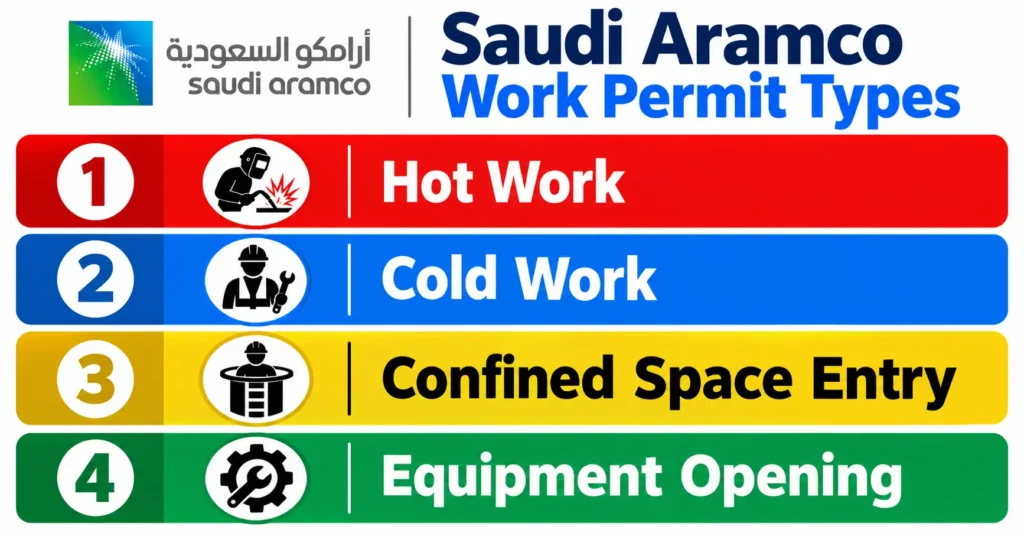
The 4 Standard Types of Aramco Work Permits
| Permit Type | Color Code | Primary Application Examples | Key Safety Requirements |
|---|---|---|---|
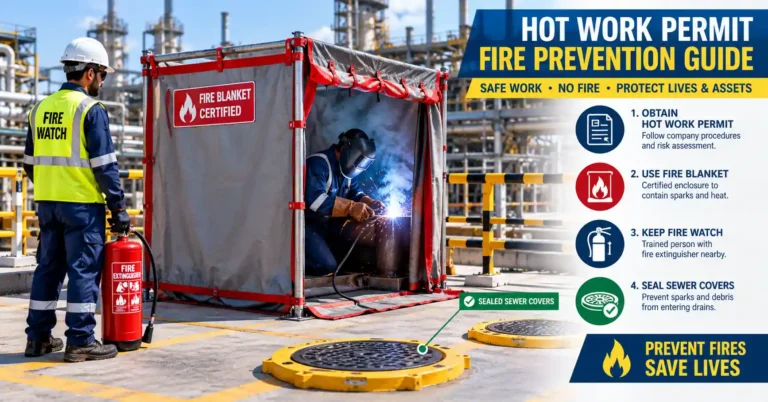
| Hot Work Permit | Red | Welding, grinding, cutting, open flames, vehicle entry into hazardous areas. | Fire watch, fire extinguisher, 35 ft (11 m) combustible clearance, continuous gas testing. |
| Cold Work Permit | Blue | Scaffolding erection, manual painting, hand tool operation, civil piping installation. | Personal Protective Equipment (PPE), basic hazard assessment, isolation verification. |
| Confined Space Entry | Yellow | Storage tanks, excavations over 1.2 meters deep, vessels, boilers, sewers. | Standby man, entry log, forced ventilation, toxic/combustible gas testing. |
| Equipment Opening / Line Break | Green | Opening process piping, breaking flanges, bleeding pressure vessels, valve removal. | Lockout/Tagout (LOTO), depressurization, draining/flushing verification, blind installation. |
Critical Atmospheric Testing Thresholds & Gas Limits
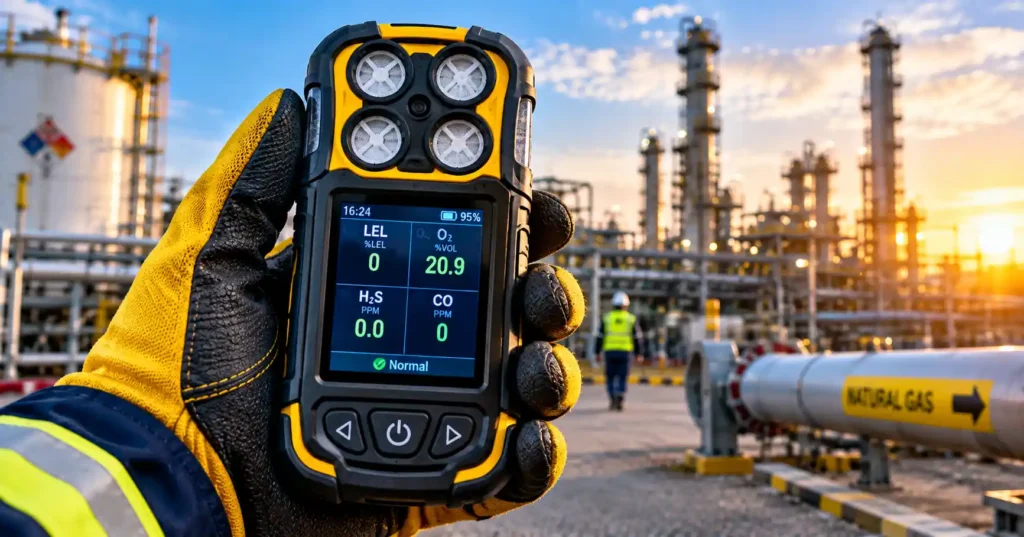
Gas testing is one of the most heavily tested topics in the Aramco WPR certification exam. Receivers must know the exact permissible exposure limits (PEL) and safety cut-offs for oxygen, combustible gases, and toxic vapors.
Gas Testing Parameters for WPR Exam
- Oxygen (O₂) Concentration: Normal level is 20.9%. Minimum safe entry is 20.0%; maximum allowable limit is 23.5%.
- Lower Explosive Limit (LEL) for Combustible Gases: Hot Work and Cold Work limit is strictly 0% LEL. Work must stop immediately if LEL reaches 1% or higher.
- Hydrogen Sulfide (H₂S) Concentration: Permissible limit without breathing apparatus is < 10 PPM. SCBA is required above 10 PPM. IDLH threshold is 100 PPM.
- Carbon Monoxide (CO) Limit: Maximum allowable limit is 35 PPM.
Real Saudi Aramco WPR Exam Questions & Detailed Answers
The following scenario-based Saudi Aramco WPR Exam Questions represent official test structures and technical evaluations used during Aramco WPR certification exams.
Section 1: Work Permit System & GI 2.100 Rules
Q1: Who is authorized to sign and issue a Saudi Aramco Work Permit at the job site?
- A) Any safety officer with a NEBOSH certificate.
- B) The certified Work Permit Receiver only.
- C) A certified Work Permit Issuer designated by Aramco Operations.
- D) The contractor project manager.
Explanation: Only an Aramco-certified Work Permit Issuer who has operational control over the specific facility or area can officially issue and sign the permit.
Q2: What is the maximum initial validity period for a standard Saudi Aramco Work Permit?
- A) 24 hours
- B) 12 hours or one operational shift
- C) 8 hours or one operational shift
- D) 48 hours
Explanation: A standard work permit is valid for a maximum of 8 hours or one operational shift. Extensions require formal re-issuance procedures under GI 2.100.
Q3: When must a Joint Site Inspection be performed by the Issuer and Receiver?
- A) After the work is completed to clean the site.
- B) Immediately before the permit is signed and issued.
- C) 24 hours before the work starts.
- D) Only if the work involves confined space entry.
Explanation: A Joint Site Inspection is mandatory immediately before issuing any permit to verify that all physical isolation, blindings, and fire protection controls are active.
Section 2: Gas Testing & Hazard Identification
Q4: During a hot work activity, your gas detector registers 2% LEL of combustible gas. What action must the WPR take?
- A) Continue working but increase ventilation.
- B) Lower the welding current and notify the foreman.
- C) Immediately stop all hot work, evacuate the area, and inform the Issuer.
- D) Re-calibrate the gas testing instrument while work continues.
Explanation: Hot work is strictly prohibited if the LEL exceeds 0%. Work must be stopped immediately and the area made safe.
Q5: What is the minimum depth of an excavation at which it is automatically classified as a Confined Space under Aramco rules?
- A) 0.5 meters (1.6 ft)
- B) 1.2 meters (4.0 ft)
- C) 2.0 meters (6.5 ft)
- D) 1.5 meters (5.0 ft)
Explanation: Any excavation deeper than 1.2 meters (4 feet) is classified as a confined space due to potential gas accumulation, lack of natural ventilation, and cave-in hazards.
Section 3: Fire Watch & Emergency Isolation
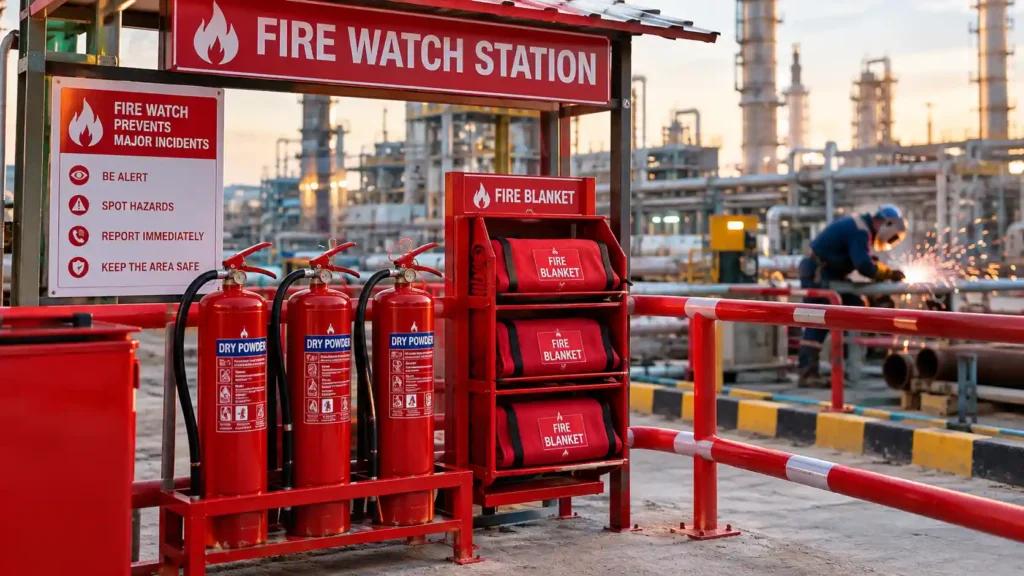
Q6: How long must a designated Fire Watch remain at the job site after hot work activities are completed?
- A) At least 15 minutes
- B) At least 30 minutes
- C) Exactly 1 hour
- D) No waiting period is required if the area is wet.
Explanation: Aramco safety standards mandate that a dedicated Fire Watch must monitor the hot work area for a minimum of 30 minutes after welding or cutting stops to ensure no smoldering embers trigger a fire.
Q7: What distance must combustible materials be cleared or protected from a hot work location?
- A) 10 feet (3 meters)
- B) 20 feet (6 meters)
- C) 35 feet (11 meters)
- D) 50 feet (15 meters)
Explanation: All combustible materials within a 35-foot (11-meter) radius of hot work must be removed or covered with certified fire-retardant blankets.
Practical Insights & Field Notes
Field Experience Note:
As an Aramco Certified Work Permit Receiver (WPR) with over 05 years of hands-on field experience across Saudi oil & gas sites, I always advise candidates to prepare strategically and understand the practical responsibilities of a Work Permit Receiver not just memorize exam questions.
Before applying, make sure your ATS-friendly CV clearly highlights your WPR certification, relevant site experience, safety responsibilities, and oil & gas background. A well-structured CV can also help when submitting your profile for vendor or contractor registration.
For WPR exam preparation, candidates should study the relevant Saudi Aramco GI safety standards, permit-to-work requirements, and site safety procedures. Trusted preparation resources such as Abu Abbas WPR study notes can be useful for revision, but candidates should always verify important requirements against the applicable official procedures and current site instructions.
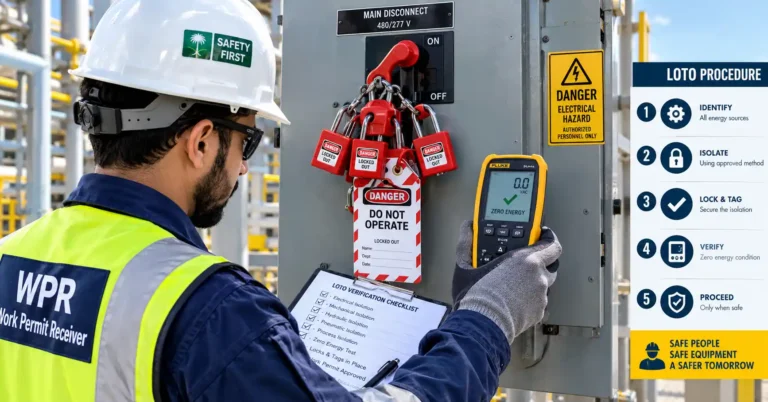
Based on field experience, special attention should be given to LOTO (Lockout/Tagout) isolation verification, gas testing, continuous gas monitoring, permit conditions, SIMOPS, PPE requirements, confined-space controls, and emergency procedures. Understanding why each control is required is more valuable than simply memorizing answers.
Key Areas to Prepare
– Work Permit Receiver responsibilities
– Permit-to-Work (PTW) system
– LOTO and isolation verification
– Gas testing and continuous monitoring
– LEL, O₂, H₂S and CO limits
– Confined-space entry requirements
– Hot work and cold work permits
– Excavation and lifting safety
– SIMOPS and hazard identification
– PPE and emergency response
– Toolbox talks and JSA/JHA/HIRA
– Permit suspension, extension and close-out
Practical Advice: Don’t prepare only for the examination. Prepare yourself to demonstrate safe decision making in real site situations. During an interview or site evaluation, be ready to explain how you verify isolation, interpret gas test readings, identify hazards, communicate with the Permit Issuer, and stop work when conditions become unsafe.
Common Mistakes That Cause Candidates to Fail
- Confusing Issuer vs. Receiver Roles: Remember that the Receiver requests and accepts the permit, while the Issuer authorizes and issues it.
- Ignoring Environmental Factors: Wind direction is critical when performing gas testing or setting up hot work near hydrocarbon processing units. Always position equipment upwind.
- Misunderstanding Permit Extensions: Permits cannot be extended indefinitely. Extended turnaround shifts require specific signatures from higher Aramco operations management.
Final Checklist for Aramco WPR Exam Success
Before walking into your Aramco WPR certification exam, ensure you can confidently answer questions on:
- GI 2.100 (Work Permit System)
- GI 6.012 (Isolation, Lockout/Tagout Procedures)
- GI 2.709 (Gas Testing Procedures)
- GI 7.000 (Scaffolding Safety Standards)
By mastering these standards and practicing scenario-based questions, you will secure your certification and contribute to a zero-incident safety culture across Saudi Aramco projects.
For more industrial safety updates, visit our Home Page.
One Comment