Hot Work Permit Requirements & Fire Prevention Guide
Executive Technical Summary
Hot work activities within oil, gas, and petrochemical facilities introduce ignition sources into high-risk process zones. This technical guide outlines regulatory compliance mandates under Saudi Aramco GI 2.100, SABIC SHEM standards, and NFPA 51B. Work Permit Receivers (WPR) must ensure strict 0.0% LEL gas verification, positive spark containment, continuous fire watch coverage, and post-work monitoring to prevent catastrophic industrial fires.
Join Saudi Arabia’s Premier Industrial Safety Network
Access verified WPR exam practice questions, Aramco/SABIC safety updates, and technical loss prevention resources on our official WhatsApp channel.
Regulatory Scope and Classification of Hot Work Permit Requirements & Fire Prevention
In hydrocarbon processing complexes, hot work is defined as any maintenance, construction, or repair operation capable of producing sufficient heat, sparks, open flames, or friction to ignite combustible vapors or materials. Under Saudi Aramco General Instruction GI 2.100 and SABIC SHEM loss prevention guidelines, hot work activities strictly require a valid Hot Work Permit issued prior to job execution.
Common examples of hot work include open-flame welding, abrasive grinding, flame cutting, thermal spraying, internal combustion engine operation within hazardous zones, and the use of non-intrinsically safe electrical tools. Work Permit Receivers (WPR) must classify work areas accurately to ensure appropriate fire containment measures are implemented before authorizing site activities.
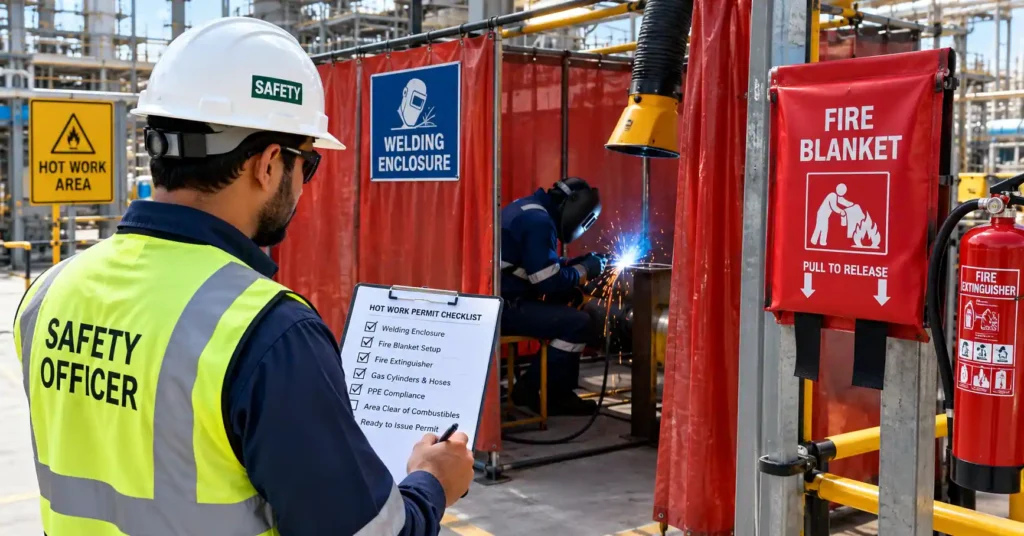 Certified safety officer inspecting a welding enclosure and fire blanket setup before issuing a hot work permit.
Key Fire Prevention Controls and Site Preparation Standards
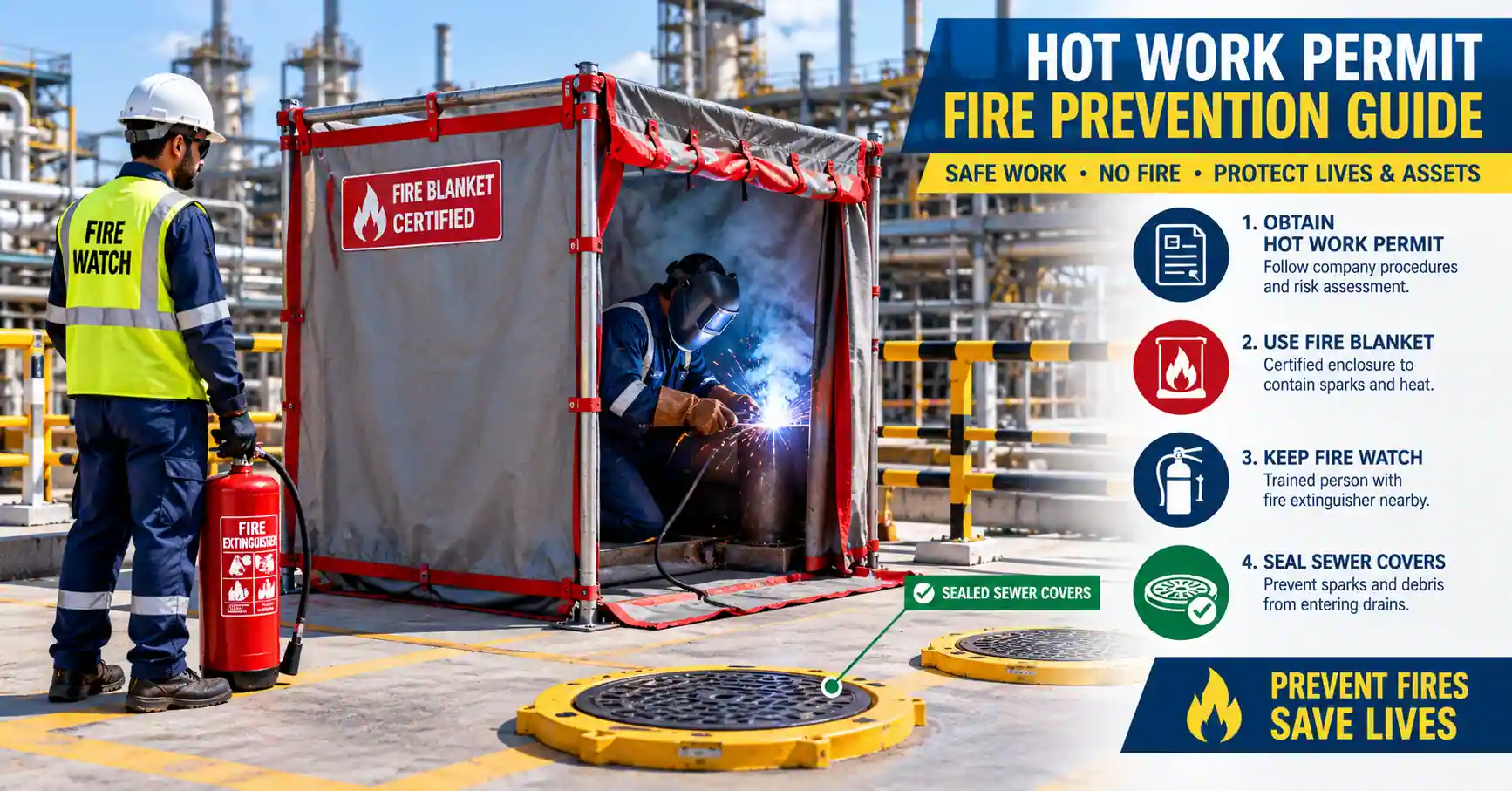
Preventing ignition events requires a multi layered barrier strategy. Before hot work can commence, the work zone within a 15 meter (50 foot) radius must undergo thorough physical and chemical mitigation.
- Combustible Material Elimination: Remove all loose hydrocarbon deposits, grease, paper, wooden pallets, and flammable waste from the 15-meter hot work boundary.
- Drain and Sewer Isolation: Cover all oily water sewers, catch basins, open drain funnels, and valve pits with fire-retardant tarpaulins or rubber sheets, sealed around the edges with clean sand to prevent vapor migration.
- Spark Containment Enclosures: Erect habitat enclosures constructed from certified fire-resistant blankets (conforming to NFPA 701 standards) to contain grinding sparks and slag within the immediate work zone.
- Fire Equipment Positioning: Deploy a minimum of two fully inspected 30 lb multi-purpose dry chemical (ABC or BC) fire extinguishers alongside charged fire hose lines where required by facility risk assessments.
Saudi Aramco & SABIC Hot Work Permit Verification Protocol
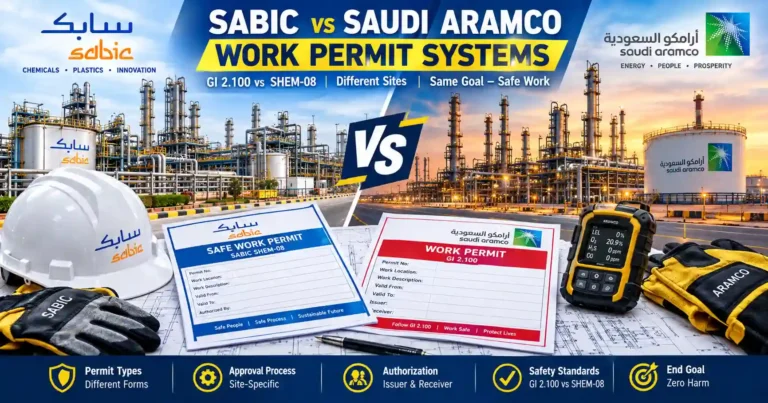
Before initiating flame, arc, or grinding operations, the Work Permit Receiver (WPR) and Issuer must physically verify every safety check item listed on the official Hot Work Permit form. The permit must remain displayed at the job site inside an all-weather transparent protective pouch throughout the operational shift.
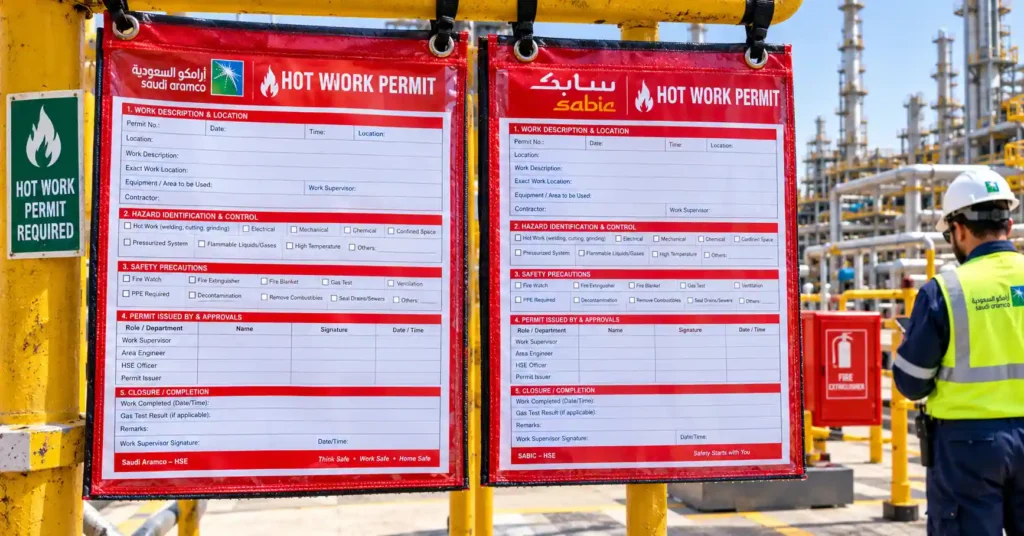 Official Saudi Aramco and Sabic Hot Work Permit form displayed at an active plant job site under GI 2.100 safety standards.
Every valid Hot Work Permit requires joint signatures, certified Gas Testing Technician (GTT) readings, fire watch designation, and explicit work area isolation details. Operating without an active, signed permit posted at the site results in immediate work stoppage and safety compliance penalties.
Hot Work Safety: Fire Watch Responsibilities and Field Experience
During a turnaround at an olefins plant in Jubail, I witnessed a flash fire when hot grinding sparks passed through an unsealed sewer cover and ignited residual light hydrocarbons. The fire watch responded immediately, helping contain the incident within seconds. This experience demonstrated the importance of proper drain sealing and continuous fire prevention.
With 15 years of experience as a Safety Officer in SABIC and Saudi Aramco environments, including EPM and PMT approvals, I consider fire watch supervision a critical part of industrial safety.
Key Fire Watch Responsibilities
- Permit verification: Review the work permit, understand the hazards, and confirm the assigned location and activity with the Work Permit Receiver (WPR).
- Area inspection: Remove combustible materials, verify housekeeping, and ensure nearby drains and sewer openings are sealed where required.
- Fire protection: Check the availability and accessibility of suitable fire extinguishers, welding screens, and fire blankets.
- Continuous monitoring: Watch for sparks, hot particles, smoke, and changing site conditions throughout the activity.
- Dedicated attendance: Never leave the work area unattended. If a replacement is needed, suspend the activity until an authorized person takes over according to site procedures.
- Gas monitoring: Ensure atmospheric testing and monitoring follow the permit requirements. Stop work if readings become unsafe or an alarm activates.
Activities Requiring Fire Risk Assessment
Fire watch requirements may extend beyond welding, cutting, and grinding. Depending on the hazard assessment and plant procedures, vehicle entry into hydrocarbon areas, lifting operations, and other activities involving potential ignition sources may require additional fire prevention controls and designated personnel.
My Professional Safety Principle
No hot work should begin until the required permit authorization, gas testing, housekeeping, fire protection equipment, and designated personnel are confirmed. Every team member must understand their responsibilities and respond immediately to unsafe conditions.
A small spark can cause a major industrial incident when combustible materials or flammable hydrocarbons are present. Proper planning, effective supervision, and strict compliance with site procedures help protect workers, equipment, and plant assets.
Safety is a responsibility, not a formality. Safety Always Comes First!
Atmospheric Gas Testing Mandatory Thresholds for Hot Work
Atmospheric monitoring is the foundational requirement for hot work approval. Certified Gas Testing Technicians (GTT) must perform initial baseline atmospheric checks from outside the execution zone prior to issuing the permit.
Under Saudi Aramco GI 2.100 and SABIC SHEM regulations, hot work limits are strictly non-negotiable:
- Lower Explosive Limit (LEL): Must strictly read 0.0% LEL. Any measurable combustible vapor reading above 0.0% prohibits hot work permit issuance.
- Oxygen (O2) Concentration: Must read strictly between 19.5% and 23.5%. Oxygen levels above 23.5% create an extreme fire hazard where materials ignite easily and burn violently.
- Toxic Gases (H2S & CO): Hydrogen Sulfide (H2S) must read 0.0 ppm, and Carbon Monoxide (CO) must remain well within permissible threshold limits (< 25 ppm).
| Parameter | Hot Work Maximum Threshold | Cold Work Comparison Threshold | Mandatory Action if Exceeded |
|---|---|---|---|
| Combustible Vapors (LEL) | 0.0% LEL (Strict zero tolerance) | < 10% LEL | Stop work instantly, revoke permit, re-clean area |
| Oxygen (O2) | 19.5% – 23.5% | 19.5% – 23.5% | Evacuate site, purge area, re-test gas atmosphere |
| Hydrogen Sulfide (H2S) | 0.0 ppm | < 10 ppm (with SCBA) | Stop work, isolate toxic gas source, re-test |
Technical Safety Highlight
Continuous gas testing is mandatory throughout hot work execution inside process areas. If atmospheric gas testing indicates any upward shift in LEL above 0.0%, all hot work must cease immediately and permit isolation must be re-verified.
Mandatory Roles and Responsibilities of the Fire Watch
The Fire Watch is a trained safety custodian stationed dedicatedly at the hot work execution point. According to NFPA 51B and Saudi Aramco GI 2.100 mandates, a Fire Watch must perform the following critical duties:
- Verify that all fire protection equipment is tested, inspected, and positioned within immediate reach before work begins.
- Ensure grinding sparks, welding slag, and heat radiation remain safely contained within fire blankets or enclosures.
- Maintain continuous visual observation over the immediate hot work activity and surrounding lower elevations.
- Stop hot work immediately if site conditions change, sewer covers shift, or gas alarms trigger.
- Remain at the work location for at least 30 minutes after completion of hot work to check for smoldering embers or hidden ignition sources.
Scenario Based WPR Examination Practice MCQs
Prepare for your Saudi Aramco and SABIC Work Permit Receiver certification assessments with these field scenario questions:
Q1: A welder is assigned to perform torch cutting on a pipe rack structure adjacent to an active hydrocarbon line. Gas testing reads 0.0% LEL, O2: 20.9%, and H2S: 0 ppm. What critical preparation is required before igniting the torch?
- A) Begin cutting immediately since the gas test passed.
- B) Cover nearby oily water sewers within 15 meters with rubber sheets/sand and deploy a dedicated Fire Watch with an inspected extinguisher.
- C) Post a safety sign and proceed without continuous fire watch.
- D) Increase fuel gas pressure on the cutting torch.
Correct Answer: B
Engineering Rationale: Even with 0.0% LEL gas readings, hot work sparks can travel up to 11 to 15 meters. Sealing all nearby sewers and posting a qualified Fire Watch with fire extinguishing equipment is a mandatory physical barrier requirement under GI 2.100.
Q2: During hot work grinding inside a process module, the Fire Watch observes hot sparks escaping through a torn seam in the fire blanket enclosure. What is the immediate required action?
- A) Allow the welder to finish the joint before fixing the blanket.
- B) Instruct the welder to stop grinding immediately and repair/reseal the fire blanket enclosure before resuming work.
- C) Spray water on the ground and ignore the blanket tear.
- D) Step away to find a new fire blanket while grinding continues.
Correct Answer: B
Engineering Rationale: The Fire Watch has direct authority to stop work whenever safety containment barriers fail. Sparks escaping an enclosure represent an uncontrolled ignition hazard.
Essential Industrial Safety Resources
Expand your technical safety compliance knowledge with our core professional guides:
- Review overall certification standards in our Saudi Aramco WPR Exam 2026 Guide.
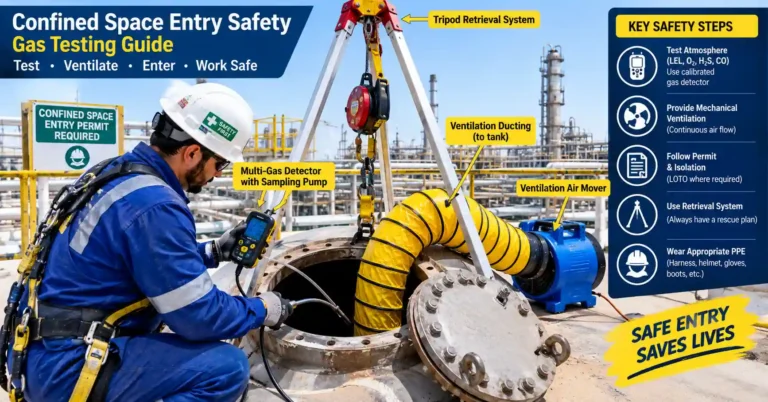
- Understand critical vessel entry procedures in our Confined Space Entry Safety and Gas Testing Guide.
What is the maximum allowable LEL reading for hot work approval?
Under Saudi Aramco GI 2.100 and SABIC SHEM standards, the maximum allowable Combustible Gas (LEL) reading for hot work approval is strictly 0.0% LEL. Any detectable flammable vapor concentration prohibits hot work authorization.
How long must a Fire Watch remain at the work site after hot work stops?
The Fire Watch must remain at the job location for a minimum of 30 minutes following the completion of hot work to inspect for hidden smoldering embers, hot slag accumulation, or delayed ignition hazards.
What distance around hot work must be cleared of combustible materials?
A minimum radius of 15 meters (50 feet) around the hot work site must be cleared of loose combustibles, hydrocarbon spills, and unsealed sewer drains prior to issuing a Hot Work Permit.
Can a Fire Watch perform secondary maintenance tasks while monitoring hot work?
No. A Fire Watch must have no other operational or secondary duties that distract from continuous monitoring of the hot work activity and immediate fire risks.
Author Engineering Credentials & Technical Governance
Lead Author: Senior Technical Safety Engineer & Industrial Loss Prevention Consultant holding over 15 years of operational expertise in oil, gas, and petrochemical complexes across Eastern Province, Saudi Arabia (Saudi Aramco facilities, SABIC Petrokemya, Kemya, S-Khem, Hadeed, Sadara, yansib, Sharq, Arrazi, Yanpet and Yansib).
Governing Industrial Standards & Codes Referenced:
- Saudi Aramco General Instruction GI 2.100 (Work Permit System Compliance)
- SABIC Environment, Health, Safety, and Security Standards (SHEM Fire Prevention Mandates)
- NFPA 51B (Standard for Fire Prevention During Welding, Cutting, and Other Hot Work)
- OSHA 29 CFR 1910.252 (General Requirements for Welding, Cutting, and Brazing)
One Comment