Excavation and Trenching Safety Standards WPR Guide
Executive Technical Summary
Underground civil work, earthmoving, and deep trenching within hydrocarbon processing complexes carry severe risks of cave-ins, structural collapses, toxic vapor accumulation, and accidental strikes on live underground utilities. This loss prevention manual establishes mandatory compliance rules under Saudi Aramco General Instruction GI 1021.000, SABIC SHEM guidelines, and OSHA 29 CFR 1926 Subpart P. Certified Work Permit Receivers must enforce pre-excavation utility clearances, soil stability assessments, protective sloping or benching, and continuous hazardous gas monitoring before allowing site entry.
Join Saudi Arabia’s Premier Industrial Safety Network
Access verified WPR exam practice questions, Aramco/SABIC safety updates, and technical loss prevention resources on our official WhatsApp channel.
Regulatory Governance and Technical Definitions of Excavation and Trenching Safety Standards WPR Guide
Excavation work in petrochemical plants, crude oil tank farms, and cross-country pipeline corridors represents one of the most hazardous civil activities in heavy industry. Under Saudi Aramco GI 1021.000 (Excavation Safety) and SABIC SHEM standards, any man-made cut, cavity, trench, or depression formed by earth removal requires strict administrative and physical controls. An excavation is legally defined as a Trench if its depth exceeds its width, provided the width measured at the bottom does not exceed 4.5 meters (15 feet).
Any excavation reaching a depth of 1.2 meters (4 feet) or greater is automatically classified as a Confined Space under Saudi Aramco loss prevention rules. Consequently, executing deep trenching operations requires issuing both a valid Excavation Work Permit and a Confined Space Entry Permit, accompanied by continuous atmospheric testing for hazardous gases, flammable vapors, and oxygen deficiency.
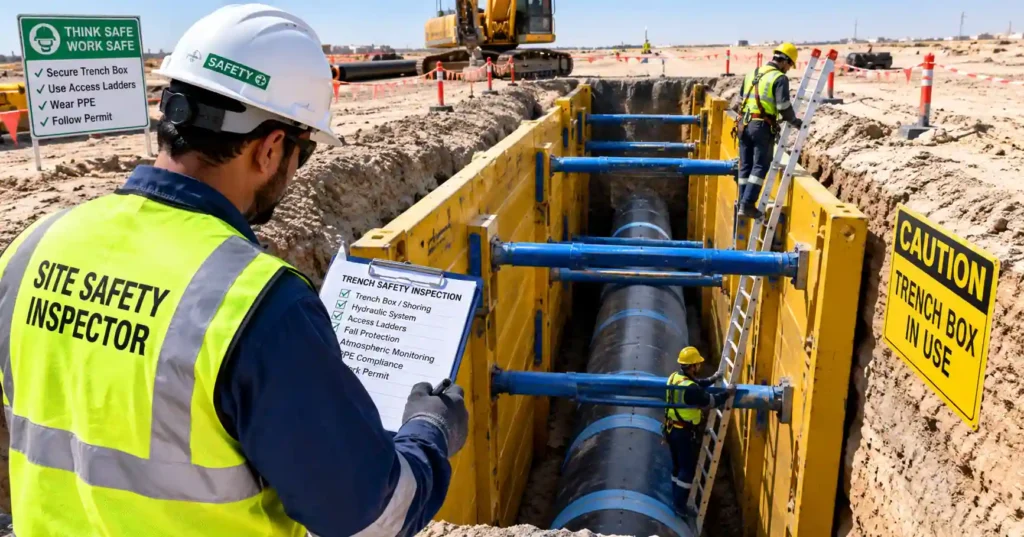 Certified safety inspector checking structural hydraulic shoring struts and ladder extension height inside a deep utility trench under GI 1021.000 guidelines.
Underground Utilities Detection and Manual Hand Digging Limits
Striking buried electrical power cables, high-pressure gas lines, fiber optic communications, or pressurized water pipes during mechanized digging can trigger catastrophic plant shutdowns, explosions, or immediate electrocution. To mitigate utility strike hazards, Saudi Aramco GI 1021.000 enforces a strict multi-tier verification process:
- Utility Scan and Clearance Certificate: Prior to breaking ground, a comprehensive underground clearance review must be conducted utilizing Ground Penetrating Radar (GPR) and electromagnetic cable locators. All facility drawings, civil plot plans, and piping IDs must be reviewed and signed off by electrical, instrument, and proponent engineers.
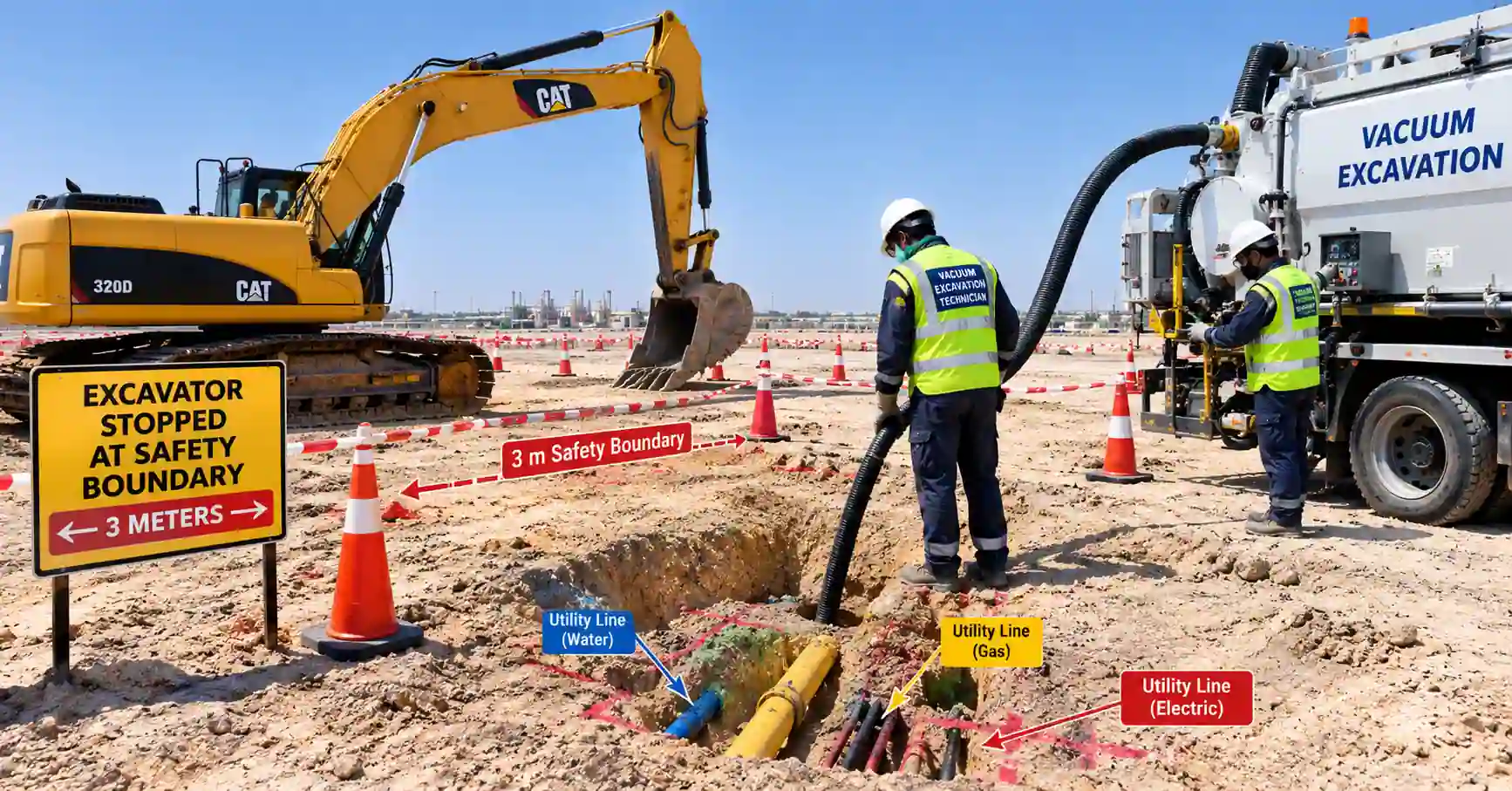
- Mechanical Digging Boundary: Mechanized excavators, backhoes, and trenchers are strictly prohibited from operating within 3 meters (10 feet) of any known underground pipe, electrical cable, or conduit.
- Hand-Digging Zone: Within the 3-meter boundary, personnel must utilize non-conductive manual hand tools (such as wooden-handled shovels) or non-destructive vacuum excavation methods until the utility is fully exposed and physically verified.
Geotechnical Soil Mechanics and Classification Criteria
Soil stability varies dramatically based on moisture content, previous disturbances, granular cohesion, and mechanical loading. Soil deposits are classified into three core engineering tiers under OSHA and Saudi Aramco standards:
- Type A Soil: Cohesive soils with an unconfined compressive strength of 1.5 tons per square foot (tsf) or greater (e.g., hard clay, cemented caliche). Unfractured, stable rock also falls under this top structural tier. Note: Soil cannot be classified as Type A if it is fissured, subject to vibration from heavy plant equipment, or previously disturbed.
- Type B Soil: Cohesive soils with an unconfined compressive strength between 0.5 tsf and 1.5 tsf, or granular cohesionless soils such as gravel, silt, silt loam, and previously disturbed soils that do not exhibit fissuring. Most compacted industrial backfills across Saudi Arabian plant sites fall into Type B.
- Type C Soil: Cohesive soils with an unconfined compressive strength of 0.5 tsf or less, including loose sand, submerged soil, soil from which water is freely seeping, or unstable rock formations. Due to environmental conditions, uncompacted desert sand across Eastern Province sites is automatically treated as Type C soil.
Engineering Protective Systems: Sloping, Benching, and Shoring
Unless an excavation is formed entirely in stable solid rock, excavations deeper than 1.2 meters (4 feet) must incorporate an engineered protective system to shield workers against sidewall shear failure and soil movement.
| Soil Classification | Maximum Allowable Angle | Sloping Ratio (Horizontal:Vertical) | Engineering Protective Requirements |
|---|---|---|---|
| Stable Rock | 90 Degrees | Vertical (90°) | Visual inspection for loose rock fragments |
| Type A Soil | 53 Degrees | 3/4 : 1 | Sloping, simple benching, or timber shoring |
| Type B Soil | 45 Degrees | 1 : 1 | Sloping, multiple benching, or hydraulic shoring |
| Type C Soil | 34 Degrees | 1.5 : 1 | Sloping 1.5:1 ratio or certified trench shield box (No Benching) |
Technical Safety Highlight
Benching is strictly prohibited in Type C soil. Because loose sand and gravel lack internal cohesion, benching steps will collapse under structural weight. Type C soils require a maximum 1.5:1 slope angle or manufactured steel trench shields certified by a professional registered engineer.
Spoil Pile Management and Heavy Equipment Clearance Barriers
Extracted soil (spoil piles), heavy machinery, and construction materials placed too close to the edge of an excavation create immense superimposed loads, drastically increasing the likelihood of sudden sidewall failure.
Work Permit Receivers must enforce these minimum clearance boundaries:
Spoil Pile Setback: All excavated spoil piles, piping materials, and loose equipment must be kept a minimum distance of 0.6 meters (2 feet) from the edge of the excavation. For deep excavations exceeding 3 meters, larger setbacks must be applied based on soil mechanics.
Heavy Equipment Stop Blocks: Excavators, dump trucks, and mobile cranes must maintain a minimum distance equal to the depth of the excavation unless a certified engineered retaining wall is present. Physical stop logs or high-visibility concrete jersey barriers must be positioned to prevent haul trucks from backing over trench edges.
During an underground pipe tie-in at an active processing unit in Ras Tanura, heavy rains overnight softened the upper soil layer of an un-shored 2.5 meter deep trench in Type B clay. A haul truck carrying backfill material pulled up within 1 meter of the edge to unload. The combined weight of the truck and the adjacent spoil pile caused a sudden shear cave-in, trapping a worker’s legs. The worker was rescued safely due to an emergency trench shield in place, reinforcing why strict spoil pile setbacks and wheel stop barriers are vital.
Egress Requirements and Environmental Access Protocols
Personnel working inside deep trenches must be provided with safe, rapid means of exit in the event of gas leaks, water ingress, or structural soil movement. Under Saudi Aramco GI 1021.000, safe egress pathways must satisfy the following parameters:
- Access Distance: A ladder, ramp, or stairway must be positioned so that no worker inside the trench is more than 7.5 meters (25 feet) away from a means of egress.
- Ladder Extension: All access ladders placed inside excavations must extend at least 1 meter (3 feet) above the top landing edge and be tied off securely to prevent displacement.
- Atmospheric Monitoring: Continuous gas testing is mandatory for excavations exceeding 1.2 meters in depth. Oxygen levels must remain strictly between 19.5% and 23.5%, LEL at 0.0%, and toxic vapors (H2S) at 0.0 ppm.
Scenario Based WPR Examination Practice MCQs
Test your operational readiness for Saudi Aramco and SABIC Work Permit Receiver certification assessments with these technical scenario questions:
Q1: A contractor is preparing to dig a trench 2 meters deep in loose, uncompacted desert sand (Type C soil). What is the maximum allowable sloping angle permitted under Saudi Aramco GI 1021.000?
- A) 53 degrees (3/4 : 1 slope ratio).
- B) 45 degrees (1 : 1 slope ratio).
- C) 34 degrees (1.5 : 1 slope ratio).
- D) Vertical 90 degrees with wooden posts.
Correct Answer: C
Engineering Rationale: Uncompacted desert sand is classified as Type C soil due to zero cohesion. The maximum allowable sloping angle for Type C soil is 34 degrees, which corresponds to a 1.5:1 horizontal-to-vertical sloping ratio.
Q2: An excavation crew is digging a trench near an active electrical substation. Markings indicate an underground high-voltage power cable is located in the area. At what distance from the cable must mechanical excavator equipment stop and switch to manual hand digging?
- A) 1 meter (3 feet).
- B) 3 meters (10 feet).
- C) 5 meters (16 feet).
- D) 10 meters (33 feet).
Correct Answer: B
Engineering Rationale: Mechanized digging equipment must strictly stop at a 3 meter (10 foot) boundary around active underground utilities. Within this zone, non-conductive hand digging or vacuum excavation is legally required under GI 1021.000.
Essential Industrial Safety Resources
Expand your technical safety compliance expertise across our core engineering references:
- Review overall certification criteria in our Saudi Aramco WPR Exam 2026 Guide.
- Master heavy hoisting regulations in our Critical Lifting and Rigging Safety Standards Guide.
What standard governs excavation safety in Saudi Aramco facilities?
Saudi Aramco General Instruction GI 1021.000 (Excavation Safety) serves as the primary standard governing earthmoving, trenching, and underground utility protection across Aramco sites.
At what depth is an excavation classified as a confined space?
An excavation or trench reaching a depth of 1.2 meters (4 feet) or greater is automatically classified as a confined space, requiring a Confined Space Entry Permit and gas testing.
What is the minimum setback distance for spoil piles from trench edges?
All excavated spoil piles and construction materials must be kept back at least 0.6 meters (2 feet) from the edge of the excavation to prevent overburden cave-ins.
What is the maximum travel distance to an access ladder inside a trench?
Work personnel inside an excavation must not have to travel more than 7.5 meters (25 feet) laterally to reach a safe ladder, ramp, or egress point.
Author Engineering Credentials & Technical Governance
Lead Author: Senior Technical Safety Engineer & Industrial Loss Prevention Consultant holding over 15 years of operational expertise in oil, gas, and petrochemical complexes across Eastern Province, Saudi Arabia (Saudi Aramco facilities, SABIC Petrokemya, Hadeed, Sharq, Arrazi, and Yanpet).
Governing Industrial Standards & Codes Referenced:
- Saudi Aramco General Instruction GI 1021.000 (Excavation Safety Standards)
- SABIC Environment, Health, Safety, and Security Standards (SHEM Earthmoving Safety)
- OSHA 29 CFR 1926 Subpart P (Excavations, Trenching, and Soil Classification)
- National Utility Locating Contractors Association (NULCA Underground Facility Standards)