Scaffolding Safety and Working at Heights Standards WPR Guide
Executive Technical Summary
Falls from elevated work platforms remain a leading cause of severe trauma and fatalities across hydrocarbon refineries, chemical plants, and industrial construction sites. This loss prevention manual establishes mandatory compliance rules under Saudi Aramco General Instruction GI 8.001 (Safety Requirements for Scaffolds), SABIC SHEM guidelines, and OSHA 29 CFR 1926 Subpart L. Certified Work Permit Receivers must enforce scaffold tag verification, platform planking integrity, guardrail system checks, and 100% fall protection compliance before authorizing elevated work.
Join Saudi Arabia’s Premier Industrial Safety Network
Access verified WPR exam practice questions, Aramco/SABIC Jobs updates, safety updates, and technical loss prevention resources on our official WhatsApp channel.
Regulatory Scope, Scaffolding Safety and Working at Heights Standards Thresholds
Working at heights introduces constant gravitational hazards that require strict engineering controls, administrative permits, and personal protective equipment. Under Saudi Aramco GI 8.001 and SABIC SHEM loss prevention standards, Working at Heights is legally defined as any work activity performed where a person could fall a distance of 1.8 meters (6 feet) or more onto a lower level or surface.
Work Permit Receivers (WPR) must ensure that any elevated work area lacking standard guardrails incorporates a secondary fall protection system. Work on elevated pipe racks, vessel platforms, structural steel beams, or mobile elevated work platforms (MEWPs) requires joint verification by the WPR and Issuer to confirm structural anchoring points and platform stability before permit authorization.
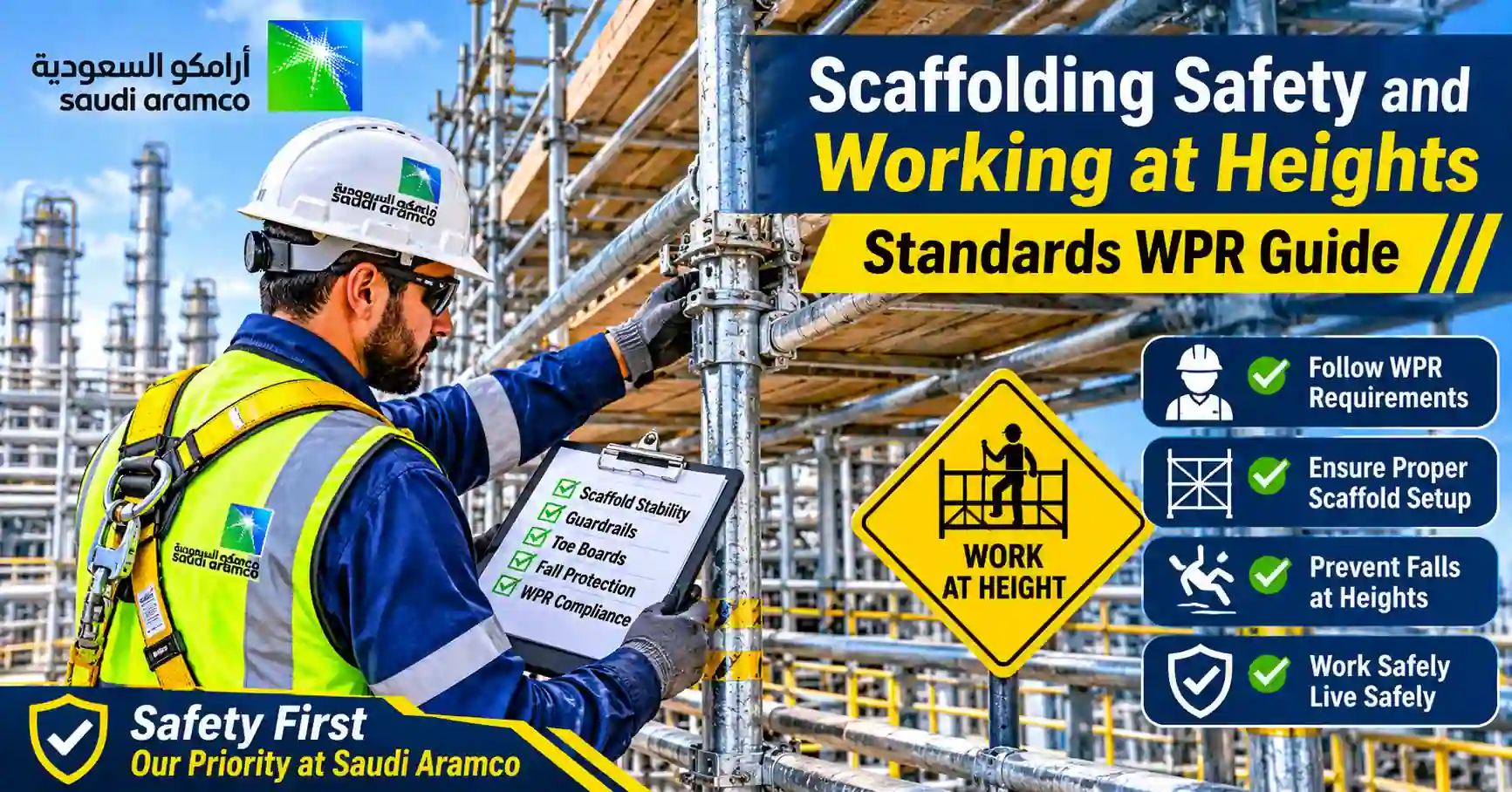
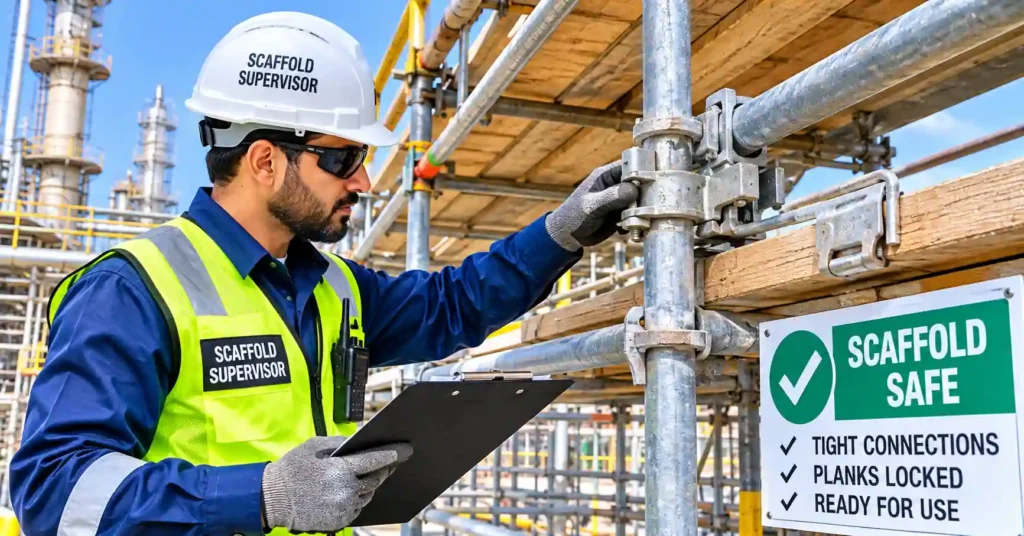 Certified scaffold supervisor inspecting modular cup-lock scaffolding node connections and plank locking devices under Saudi Aramco GI 8.001 inspection rules.
Saudi Aramco Scaffold Tagging System: Red, Yellow, and Green Tags
Scaffolds built in oil, gas, and petrochemical facilities must undergo rigorous physical inspection by certified Scaffold Inspectors or Scaffold Supervisors prior to use. Under Saudi Aramco GI 8.001, access control and operational status are governed by a strict color-coded tagging protocol:
- Red Scaffold Tag (Do Not Use): Indicates that the scaffold is incomplete, undergoing erection, modification, or dismantling, or has been deemed structurally unsafe. No personnel are permitted to mount or work from a red-tagged scaffold, except certified scaffold erectors directly engaged in its construction while utilizing 100% fall protection.
- Green Scaffold Tag (Ready for Use): Indicates that the scaffold has been fully inspected, meets all Saudi Aramco structural criteria, and includes complete working platforms, toe-boards, and mid-rails/top-rails. Fall protection lanyards are not mandatory on green-tagged scaffolds provided guardrails remain completely intact and workers stay within platform boundaries.
- Yellow Scaffold Tag (Special Conditions / Restrictions): Indicates that the scaffold cannot be fully fitted with standard guardrails due to structural interference or operational constraints. Anyone working from a yellow-tagged scaffold must wear a full-body harness and maintain 100% lanyard tie-off to an independent anchorage point at all times.
Structural Platform Integrity: Planking, Guardrails, and Outriggers
Structural stability prevents platform displacement and catastrophic collapse under dynamic loading. Work Permit Receivers must verify key physical elements during pre-job site walk-downs:
- Planking and Decking: Scaffold planks must be certified laminated veneer lumber (LVL) or steel grating meeting Aramco specifications. Planks must overlap supports by at least 150 mm (6 inches) or be cleated/secured against movement. Gaps between adjacent planks must not exceed 25 mm (1 inch).
- Standard Guardrail Systems: Top-rails must be installed between 0.95 meters (38 inches) and 1.15 meters (45 inches) above the walking surface. Mid-rails must be installed mid-way between the top-rail and working platform. Toe-boards with a minimum height of 100 mm (4 inches) are mandatory on all sides to prevent falling tools and debris.
- Foundation and Sole Plates: Base plates must rest on heavy hardwood timber sole plates (minimum thickness 50 mm, width 225 mm) to distribute upright post loads across soil or concrete surfaces. Screw jacks must not extend beyond the maximum manufacturer adjustment limit.
 Saudi Aramco Scaffold Tagging System: Red, Yellow, and Green Tags Structural Platform Integrity.
Scaffold Tag Classification Platform Guardrail Status Harness Lanyard Requirement Authorized Personnel Only Red Tag Incomplete / Missing components Mandatory for erectors only Certified Scaffold Erectors only Green Tag 100% complete (Top, Mid, Toe-board) Not mandatory if inside guardrails All authorized facility workers Yellow Tag Incomplete guardrails / Obstructions 100% Continuous tie-off mandatory Trained personnel with full harness Technical Safety Highlight
Scaffold tags expire after 14 days or immediately following major modifications, structural damage, or severe weather events (such as high wind storms exceeding 65 km/h). Work Permit Receivers must verify that green or yellow tags bear active, valid inspection signatures prior to issuing daily work permits.
Personal Fall Arrest Systems (PFAS) and Anchoring Requirements
When engineering guardrail barriers cannot eliminate fall risks, workers must utilize a Personal Fall Arrest System (PFAS). A compliant PFAS assembly comprises four essential elements: an approved full-body harness, a shock-absorbing lanyard or self-retracting lifeline (SRL), connecting hardware (carabiners/snap hooks), and a certified anchorage point.
Under Saudi Aramco safety standards, key PFAS operational rules include:
Anchorage Strength: Fall arrest anchor points must support a minimum static load of 22.2 kN (5,000 lbs) per attached worker, or be designed as part of an engineered fall protection system certified by a qualified structural engineer. Scaffolding guardrails, small conduit pipes, and instrument lines must never be used as fall protection anchorages.
100% Dual Lanyard Tie-off: Workers moving across elevated structures must utilize a double-leg (Y-lanyard) shock-absorbing assembly. One leg must remain attached to an anchor point while relocating the second leg to a new anchor point, ensuring continuous protection against falling.
Maximum Free Fall Distance: Fall arrest systems must be configured to limit free fall distance to a maximum of 1.8 meters (6 feet) to prevent excessive deceleration forces on the human body.
My Site Experience: The Importance of 100% Tie-Off During a valve maintenance project on an elevated pipe rack in Yanbu, a pipe fitter fell approximately 4 metres while moving between anchorage points. He was wearing a safety harness with a single-leg lanyard. While disconnecting to reach another anchorage point, he slipped on an oily steel beam and fell onto a lower cable tray, sustaining serious back injuries. This incident highlighted the importance of continuous fall protection. A suitable dual-leg Y-lanyard allows workers to remain connected while transferring between approved anchorage points.My Safety Observation: As a WPR, I always emphasize 100% tie-off, proper scaffold access, secure platforms, and checking for slippery surfaces before starting work at height. Never compromise fall protection during movement.Scenario-Based WPR Examination Practice MCQs
Prepare for your Saudi Aramco and SABIC Work Permit Receiver certification assessments with these field scenario questions:
Q1: A maintenance crew arrives at an elevated tower platform to replace a pressure safety valve. The scaffold displays a valid Yellow Scaffold Tag signed by an Aramco inspector. What is the mandatory safety rule for working on this platform?
- A) No work is permitted under any circumstances on a yellow-tagged scaffold.
- B) Personnel may work freely without fall protection as long as toe-boards are present.
- C) All personnel must wear full-body harnesses and maintain 100% tie-off to an independent anchor point at all times.
- D) The scaffold tag must be changed to green by the Work Permit Receiver.
Correct Answer: C
Engineering Rationale: Yellow tags indicate that standard guardrails are incomplete or missing due to site constraints. Personnel are permitted to work only if they wear full-body harnesses with continuous 100% tie-off under GI 8.001.Q2: What is the maximum allowable horizontal travel distance or time validity for a certified Scaffold Tag before a formal re-inspection is required under Saudi Aramco GI 8.001?
- A) 7 days.
- B) 14 days.
- C) 30 days.
- D) Valid indefinitely until the job finishes.
Correct Answer: B
Engineering Rationale: Saudi Aramco GI 8.001 mandates that scaffold inspections remain valid for a maximum period of 14 calendar days. After 14 days, the scaffold must be re-inspected and re-signed by a certified Scaffold Inspector.Q3: An isolation technician is connecting a fall arrest lanyard to an overhead structure. Which of the following objects is considered a certified anchorage point capable of supporting 5,000 lbs (22.2 kN)?
- A) A 1-inch electrical conduit pipe.
- B) A top-rail of a standard green-tagged scaffold.
- C) A 6-inch structural steel I-beam verified by engineering.
- D) An active small-bore copper instrument line.
Correct Answer: C
Engineering Rationale: Fall arrest anchorages must support 5,000 lbs (22.2 kN) per worker. Structural steel I-beams meet this rating, whereas conduit, instrument lines, and scaffold guardrails are strictly unapproved.Essential Industrial Safety Resources
Expand your technical safety compliance expertise across our primary engineering guides:
- Review overall certification standards in our Saudi Aramco WPR Exam 2026 Guide.
- Master underground excavation limits in our Excavation and Trenching Safety Standards Guide.
What standard governs scaffolding safety in Saudi Aramco facilities?
Saudi Aramco General Instruction GI 8.001 (Safety Requirements for Scaffolds) serves as the primary governing standard for scaffold erection, inspection, and platform safety.
What height triggers mandatory fall protection requirements?
Fall protection controls and harness requirements are triggered whenever work is performed at an elevated height of 1.8 meters (6 feet) or greater above a lower surface.
Who is allowed to work on a Red-tagged scaffold?
Only certified Scaffold Erectors using full fall protection equipment are permitted on a Red-tagged scaffold for the express purpose of building, altering, or dismantling the structure.
What is the minimum static load capacity for a fall arrest anchor point?
An anchor point used for personal fall arrest systems must support a minimum certified static strength of 5,000 lbs (22.2 kN) per attached worker.
Author Engineering Credentials & Technical Governance
Lead Author: Senior Technical Safety Engineer & Industrial Loss Prevention Consultant holding over 15 years of operational expertise in oil, gas, and petrochemical complexes across Eastern Province, Saudi Arabia (Saudi Aramco facilities, SABIC Petrokemya, Hadeed, Sharq, Arrazi, and Yanpet).
Governing Industrial Standards & Codes Referenced:
- Saudi Aramco General Instruction GI 8.001 (Safety Requirements for Scaffolds)
- Saudi Aramco Construction Safety Manual (CSM – Chapter II-5 Fall Protection)
- SABIC Environment, Health, Safety, and Security Standard SHEM-10 (Working at Heights & Scaffolding)
- OSHA 29 CFR 1926 Subpart L (Scaffolds) and Subpart M (Fall Protection)
- ANSI/ASSP Z359 (Fall Protection and Fall Arrest Safety Code)
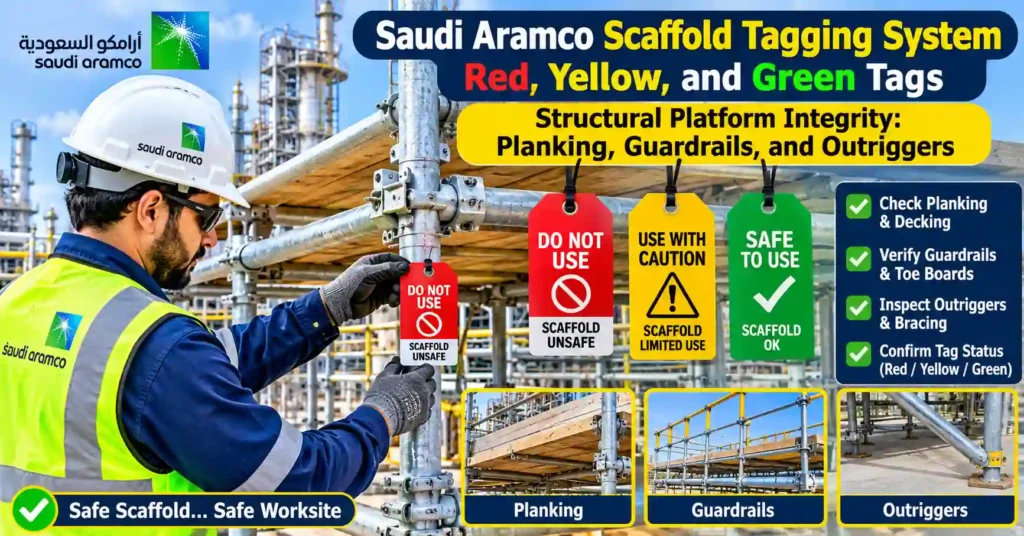 Saudi Aramco Scaffold Tagging System: Red, Yellow, and Green Tags Structural Platform Integrity.