SABIC vs Saudi Aramco Work Permit Systems
Quick Executive Summary
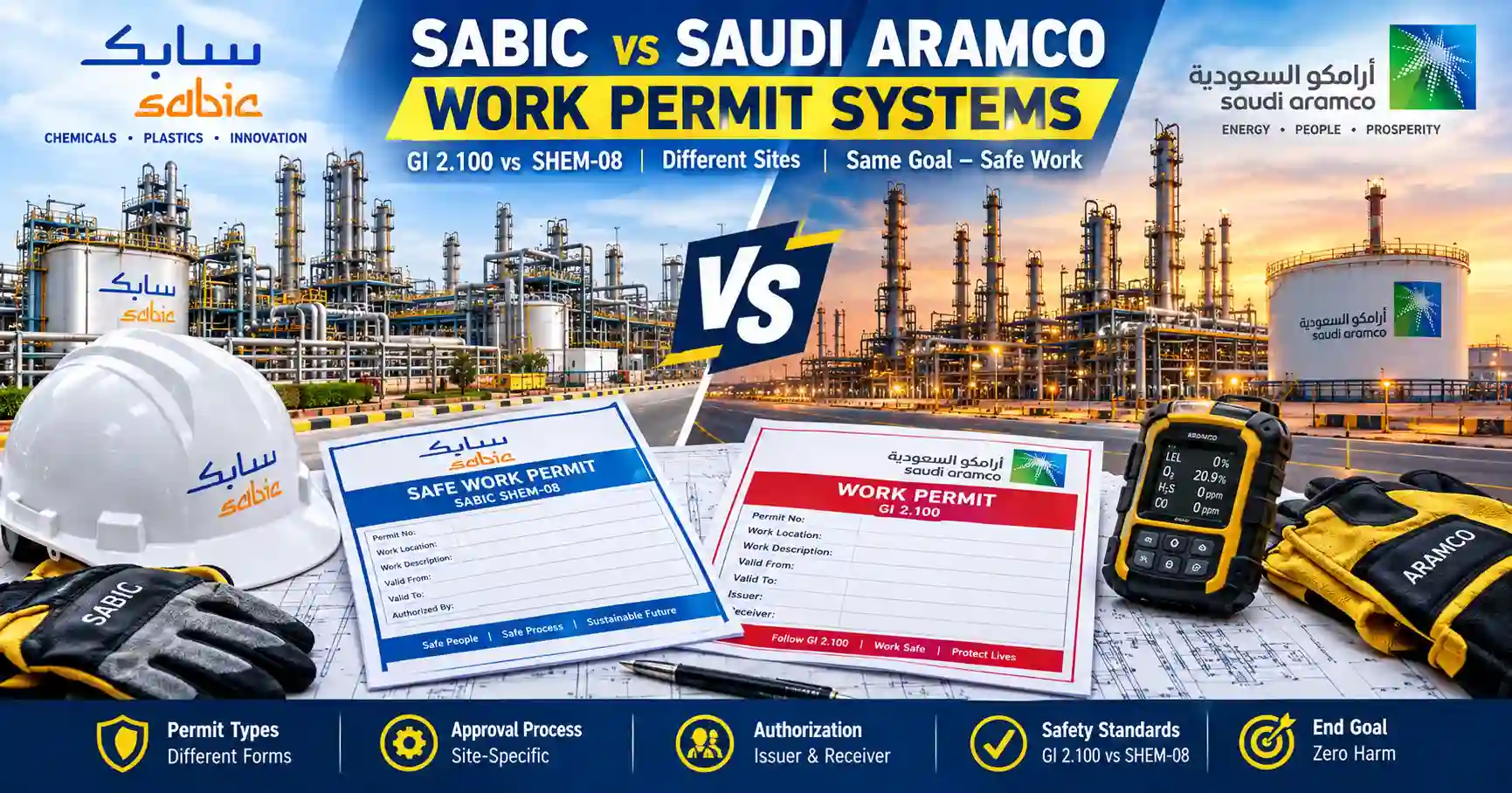
While both SABIC (SHEM-08) and Saudi Aramco (GI 2.100) prioritize field risk mitigation in hydrocarbon facilities, their execution framework differs significantly. Aramco enforces a strict 4-permit classification system with mandatory joint site inspections by certified Issuers and Receivers. In contrast, SABIC utilizes a Unified Safe Work Permit standard across affiliates (like Petrokemya, Hadeed, and Sharq) integrated with SHEM safety management elements. Key variations exist in permit color coding, valid operational hours, gas testing qualifications, and LOTO isolation practices.
Join Our VIP Saudi Industrial Safety & WPR Jobs and Exam Preparation Network!
Get real exam scenarios, updated GI/SHEM guidelines, and daily safety job notifications directly on WhatsApp & Telegram.
Introduction: SABIC vs Saudi Aramco Work Permit Systems Landscape in Saudi Arabia
Saudi Arabia’s energy and petrochemical sectors rely on rigorous safe work permit systems to eliminate workplace fatalities, fires, and toxic atmospheric releases. The two dominant entities shaping industrial safety protocols across the Kingdom are Saudi Aramco and SABIC (Saudi Basic Industries Corporation). While both companies align with global international loss prevention standards (such as OSHA 1910 and NFPA rules), contractor employees transitioning between Aramco assets and SABIC affiliate plants often encounter operational confusion due to structural differences in their permit governance.
Saudi Aramco governs field work authorizations primarily through General Instruction GI 2.100 (Work Permit System). On the other hand, SABIC operates under its proprietary SHEM-08 (Safety, Health, and Environment Management Standard for Work Permit Systems). Understanding these core framework variations is crucial for Work Permit Receivers (WPRs), Safety Officers, Site Supervisors, and Project Managers to ensure regulatory compliance and maintain incident-free operations.
Key Takeaways & Governance Highlights
- Aramco Standard: Governed strictly by GI 2.100 alongside specialized GIs (GI 2.709 for Gas Testing, GI 6.012 for Isolation).
- SABIC Standard: Governed by SHEM-08 as part of the total 14-element SHEM corporate framework applicable across all affiliate plants. Note: SABIC have 8 unified Permit
- Permit Classifications: Aramco uses 4 distinct color-coded physical permits; SABIC utilizes a standardized Safe Work Permit format with specialized attachments.
- Gas Tester Qualification: Aramco requires a certified Gas Tester credential distinct from WPR; SABIC integrates gas testing protocols based on facility competent person designation.
- Reciprocal Validity: A Saudi Aramco WPR card is not automatically valid at SABIC sites and vice versa; facility-specific authorization is mandatory.
1. Regulatory Standards & Core Governance Framework
To grasp the fundamental differences, one must analyze the baseline documents that mandate work authorization procedures in each organization:
Saudi Aramco Governance (GI 2.100)
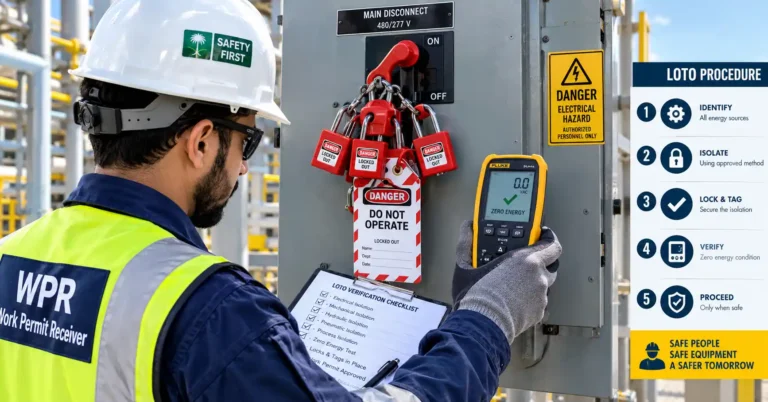
Saudi Aramco’s GI 2.100 establishes a mandatory procedure for authorizing specific high-risk operations in restricted areas or on Aramco-owned assets. The standard clearly divides hazardous tasks into four distinct permit streams, supported by auxiliary safety instructions such as GI 7.000 (Scaffolding), GI 2.709 (Gas Testing), and GI 6.012 (Isolation & Lockout/Tagout). Every individual serving as an Issuer or Receiver must pass rigorous standardized examinations administered by Saudi Aramco Training & Development or recognized Aramco-accredited institutes.
SABIC Governance (SHEM-08)
SABIC’s work permit requirements fall within its global Safety, Health, and Environment Management (SHEM) system. Specifically, SHEM-08 details the minimum requirements for issuing, approving, and closing work permits across all SABIC manufacturing affiliates (such as Petrokemya, Sharq, IBN ZAHER, Yanpet, and Hadeed). While individual SABIC plants may implement minor facility-specific procedure localized addendums, the underlying structure of SHEM-08 mandates universal accountability, baseline risk assessments, and Job Safety Analysis (JSA) validation prior to permit generation.
2. Permitting Structure and Color Coding Systems
One of the most noticeable differences in daily field operations is how work permits are visually categorized and assigned on site.
Under Saudi Aramco GI 2.100, four specific hard-copy permits exist, printed on designated colored paper stock:
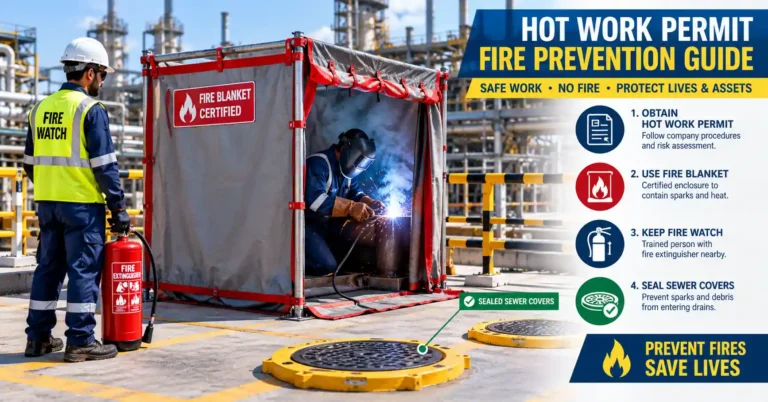
- Hot Work Permit (Red Form): Required for operations involving open flames, sparks, localized heat creation, or electrical equipment operation in classified hazardous locations (e.g., welding, grinding, torch burning).
- Cold Work Permit (Blue Form): Required for activities that do not generate sufficient heat/sparks to ignite flammable vapors, but present mechanical or operational hazards (e.g., hand tool piping disconnection, valve overhaul, structural painting).
- Confined Space Entry (CSE) Permit (Green Form): Required when personnel must physically cross a plane into any enclosed, restricted-egress space not intended for continuous occupancy (e.g., vessels, tanks, heat exchanger bundles, deep excavations).
- Release of Hazardous Liquids or Gases Permit (Yellow Form): Required when breaking open equipment, lines, or systems containing toxic substances, acid, caustic, or flammable fluids at temperatures/pressures capable of exposing personnel.
In contrast, SABIC SHEM-08 employs a unified master permit documentation structure. Instead of maintaining distinct color-coded forms for every job type, SABIC utilizes a standard Safe Work Permit (SWP) supplemented by mandatory specialized clearance certificates and checklists. For example, a single main SABIC permit will serve as the base document, to which a Confined Space Entry Certificate, Excavation Clearance, or Hot Work Safety Clearance Sheet is attached dependent on the scope of work.
3. Technical Comparison Table: SABIC vs. Saudi Aramco Work Permit Systems
| Feature / Protocol | Saudi Aramco (GI 2.100) | SABIC (SHEM-08) |
|---|---|---|
| Primary Governing Document | GI 2.100 (Supported by GI 2.709, GI 6.012) | SHEM-08 (Safe Work Permit Standard) |
| Permit Form Classification | 4 Distinct Colored Permits (Red, Blue, Green, Yellow) | Unified Safe Work Permit + Specific Checklists/Certificates |
| Maximum Shift Duration | Standard 1 Shift (Max 12 hours); extended up to 30 days under strict approval conditions. | Standard 1 Shift; renewable up to 7 consecutive days with daily endorsement. |
| Joint Site Inspection | Mandatory site walk by certified Issuer and Receiver prior to signing. | Mandatory site inspection by authorized Permit Issuer/Operator & Receiver. |
| Atmospheric Gas Testing | Conducted exclusively by an Aramco-Certified Gas Tester (AGT). | Conducted by qualified Authorized Gas Tester trained per SHEM standards. |
| LOTO / Isolation Protocol | Strict compliance with GI 6.012 lock-out/tag-out matrix & certificate. | Integrated Isolation Certificate aligned with SHEM-08/SHEM-11 rules. |
| Certification Authority | Centralized Aramco certification card (Valid for 3 years). | Affiliate/SABIC third-party authorization certificate system. |
4. Gas Testing Protocols and Environmental Standards
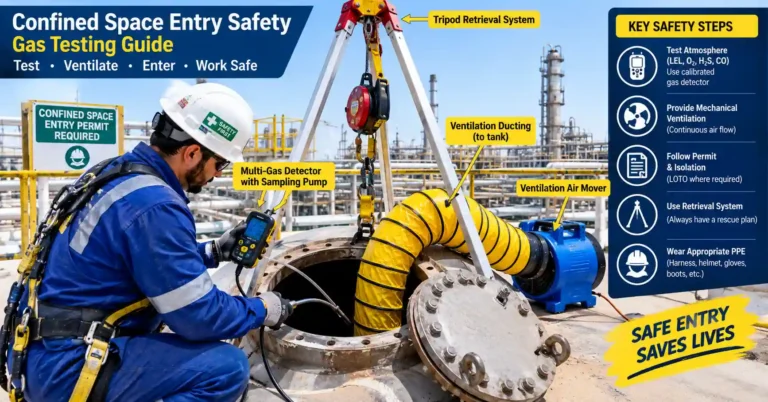
Gas testing is a non-negotiable step before issuing hot work or confined space entry permits in hydrocarbon environments. Both companies maintain strict zero-tolerance limits for toxic and flammable atmospheric exposures, but their procedural enforcement has subtle differences:
Under Saudi Aramco GI 2.709 (Gas Testing), gas testing must be conducted using a calibrated, direct-reading multi-gas instrument. The tests check four primary atmospheric indicators:
- Oxygen Level: Must be strictly between 20.0% and 23.5% (Ideal: 20.9%). Entry is prohibited if oxygen drops below 20.0% without continuous supplied-air respirators.
- Combustible Vapors (LEL): Must be 0% LEL for any Hot Work. For Cold Work, levels above 0% LEL require immediate work suspension and line purging.
- Hydrogen Sulfide (H2S): Must read 0 ppm for un-aspirated work. Any exposure above 10 ppm requires immediate SCBA protection or task shutdown.
- Carbon Monoxide (CO): Maximum permissible continuous working concentration is 25 ppm.
Under SABIC SHEM-08 rules, gas testing parameters mirror these international safety limits closely. However, SABIC affiliate procedures allow the designated Authorized Gas Tester (AGT) to document atmospheric results directly onto the specific Confined Space / Hot Work Safety Clearance Certificate attached to the unified permit, requiring immediate continuous gas monitoring when working inside live process battery limits (such as ethylene, methanol, or benzene processing units at Arrazi or Petrokemya).
[Field Experience:
Work Permits and Supporting Safety Documents:
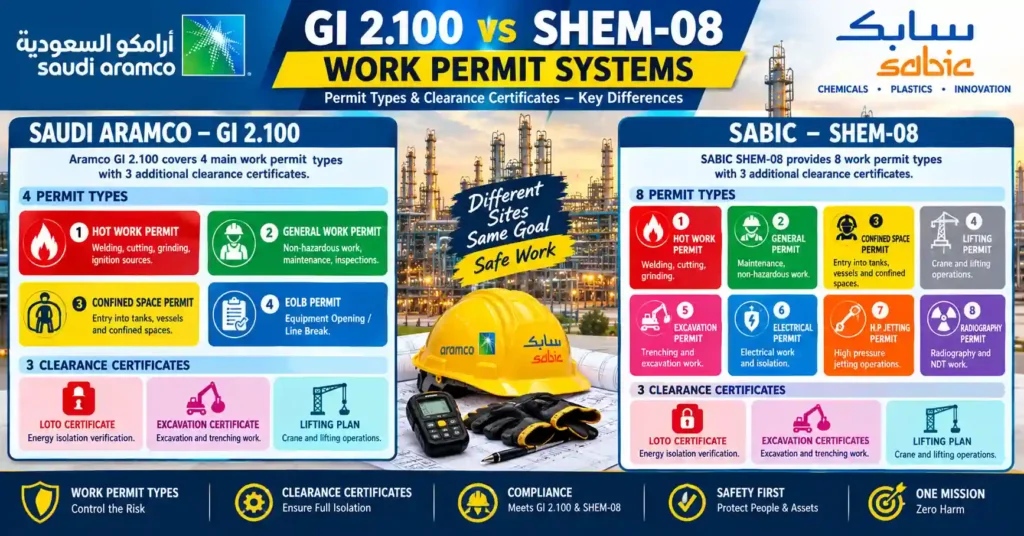
Having worked at different Saudi Aramco and SABIC industrial plants, I have observed that work permit categories and supporting safety documentation must be understood separately. Based on the permit systems discussed here, Saudi Aramco GI 2.100 is commonly associated with four main permit categories: Hot Work, General Work, Confined Space Entry, and Equipment Opening/Line Break (EOLB). The SABIC SHEM-08 system is presented here with eight categories: Hot Work, General Work, Confined Space Entry, Lifting, Excavation, Electrical Work, High-Pressure Jetting, and Radiography. However, the exact permit categories, forms, and authorization requirements must always be verified against the current controlled procedure at the specific facility.
In my field experience, supporting documents are not identical for every job or plant. Depending on the actual activity, site safety requirements, hazards, and equipment involved, the work package may require a Risk Assessment (RA), Job Safety Analysis (JSA), relevant checklists, method statements, Safety Data Sheets (SDS), applicable hazard analysis forms, LOTO/isolation documentation, gas-test records, lifting plans, excavation clearances, or other supporting certificates.
For example, a lifting operation, confined-space entry, equipment opening, and high-pressure jetting activity each have different hazards and therefore may require different supporting documents and control measures. These requirements are determined by the specific plant procedure, job scope, and conditions at the worksite not simply by the company name.
The key lesson from working across different facilities is that a permit provides authorization for defined work under specified conditions, while supporting documents demonstrate how the hazards will be assessed and controlled. Before starting any activity, the Permit Issuer, Permit Receiver, and relevant authorized personnel must verify the applicable permit, required certificates, risk assessments, isolations, and site-specific approvals. Never assume that a document accepted at one plant automatically satisfies the requirements of another.]
5. Real WPR Exam Scenario-Based MCQs with Rationale
Test your operational knowledge with these practical site scenarios commonly encountered in Saudi Aramco WPR certification exams and SABIC affiliate safety assessments:
Question 1: You are a certified Aramco Work Permit Receiver executing a hot welding job in a process plant. Suddenly, an active plant emergency alarm sounds. What is your immediate required action under GI 2.100?
- A) Continue welding if the fire watch remains present.
- B) Immediately stop all work, extinguish open flames, de-energize welding machines, cancel the permit, and instruct all personnel to evacuate to the designated Assembly Point upwind.
- C) Call the Permit Issuer on the radio to ask if you should keep working.
- D) Place the permit in the site pouch and wait 10 minutes for further notice.
Correct Answer: B
Rationale: Under Saudi Aramco GI 2.100 safety rules, in the event of an emergency or plant alarm, all work permits are automatically rendered invalid. The WPR must immediately shut down all ignition sources, ensure the work area is safe, and lead the crew to the designated muster point.
Question 2: According to SABIC SHEM-08 standards, how long is a standard Safe Work Permit typically valid for, and how can it be extended?
- A) Valid for 24 hours continuously without any re-inspection.
- B) Valid for a single operational shift; it can be re-validated/extended daily up to a maximum of 7 consecutive days if conditions remain unchanged.
- C) Valid for 30 days automatically for all civil construction projects.
- D) Valid indefinitely until the contractor finishes the job.
Correct Answer: B
Rationale: Under SABIC SHEM-08, work permits are issued on a per-shift basis. For ongoing maintenance or project work, the permit can be re-signed and endorsed for up to 7 consecutive days, provided a daily joint site inspection confirms no changes in process hazards.
6. Internal Linking & Related Safety Resources
To further prepare for safety certification tests and enhance field compliance across Saudi Arabia, explore our in-depth industrial guides:
Frequently Asked Questions (FAQs)
1. Can an Aramco certified Work Permit Receiver (WPR) work at SABIC plants using the same card?
No. While having an Aramco WPR certification demonstrates strong foundational knowledge of Saudi industrial safety rules, SABIC affiliates (such as Petrokemya, Sharq, and Hadeed) require contractors to pass plant-specific orientation, SHEM-08 permit testing, or site safety approvals before accepting work permit receiver responsibilities.
2. What are the four color-coded permits used in Saudi Aramco GI 2.100?
Saudi Aramco utilizes four color-coded work permits: Red for Hot Work, Blue for Cold Work, Green for Confined Space Entry, and Yellow for Release of Hazardous Liquids or Gases.
3. What is SHEM-08 in SABIC safety standards?
SHEM-08 is SABIC’s corporate Safety, Health, and Environment Management standard that outlines minimum requirements for the Safe Work Permit (SWP) system across all SABIC manufacturing facilities and affiliate operating plants.
4. Who is authorized to perform gas testing under Saudi Aramco rules?
Under Aramco GI 2.709, atmospheric gas testing must be conducted exclusively by an Aramco-certified Authorized Gas Tester (AGT) who holds a valid gas testing credential issued after passing the official T&D examination.
One Comment