Confined Space Entry Safety & Gas Testing WPR Guide
Executive Technical Summary
Permit-required confined space entry presents severe acute atmospheric and physical hazards within oil, gas, and petrochemical facilities. This technical reference manual details regulatory compliance mandates under Saudi Aramco GI 2.709, SABIC SHEM-08, and OSHA 29 CFR 1910.146. Work Permit Receivers (WPR) must implement rigorous three-step atmospheric testing, positive mechanical isolations, continuous forced air ventilation, and uninterrupted attendant monitoring to eliminate entry fatalities.
Join Saudi Arabia’s Premier Industrial Safety Network
Access verified WPR exam practice questions, Aramco/SABIC safety updates, and technical loss prevention resources on our official WhatsApp channel.
Regulatory Classification and Engineering Scope of Confined Space Entry Safety & Gas Testing
In industrial hydrocarbon processing units, confined spaces encompass vessels, columns, storage tanks, heat exchanger bundles, spherical bullets, underground sewer pits, and open-topped excavations deeper than 1.2 meters (4 feet). Saudi Aramco General Instruction GI 2.709 and SABIC SHEM-08 dictate that any enclosed or partially enclosed space not designed for continuous human occupancy, possessing restricted points of ingress or egress, and subject to the accumulation of toxic or flammable vapors or oxygen displacement must be governed strictly as a Permit-Required Confined Space (PRCS).
Work Permit Receivers (WPR) and Loss Prevention Engineers must evaluate physical geometry alongside chemical inventory histories prior to issuing entry permits. Entry is officially defined as the act of crossing the plane of an opening into the space with any part of the entrant’s body. Unprepped entries into unventilated process equipment remain the leading cause of multiple-fatality events in processing plants, often claiming both the primary entrant and untrained prospective rescuers.
Mandatory Pre-Entry Preparation and Hazard Isolation Protocol
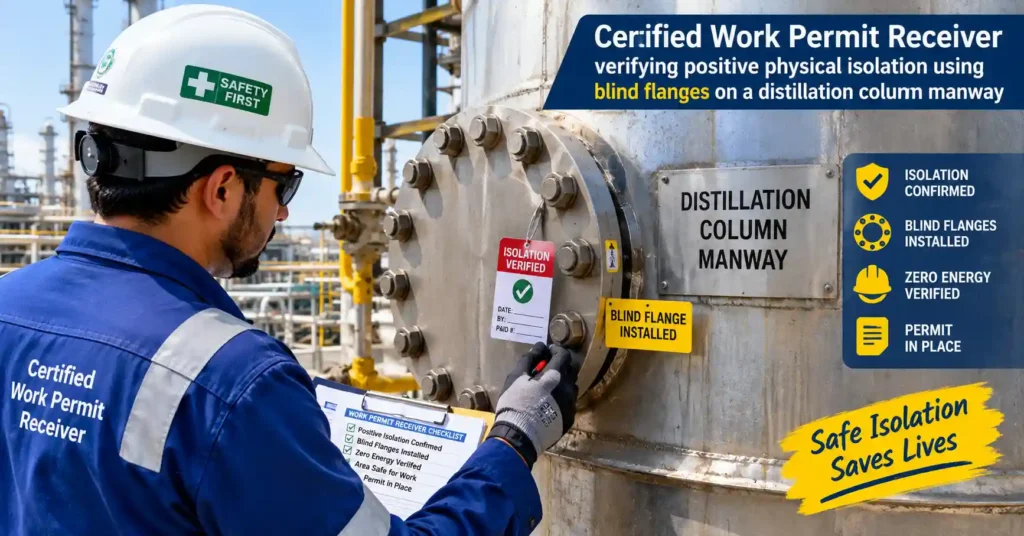
Physical isolation guarantees that process fluids, high-pressure steam, hazardous gases, and mechanical energy cannot breach the internal envelope during human occupancy. Double Block and Bleed (DBB) arrangements are strictly prohibited as primary isolation for human entry into confined spaces containing flammable or toxic materials; positive isolation via physical separation or blind installation is legally required.
- Positive Mechanical Isolation: Install rated blind flanges directly adjacent to the vessel nozzles or disconnect piping spools. Blinds must withstand maximum operating pressure and process chemical degradation.
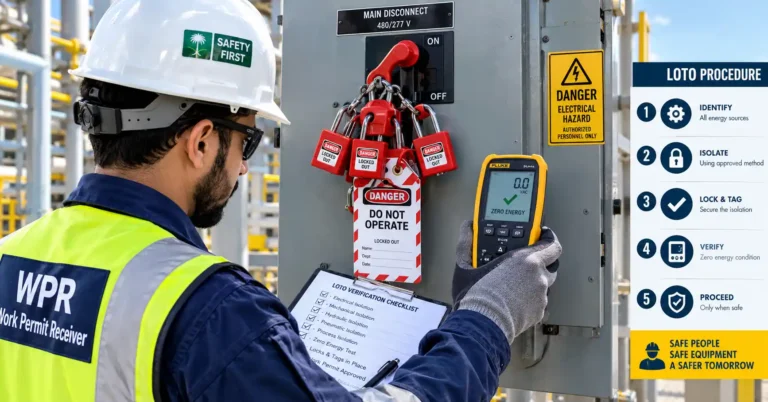
- Hazardous Energy Lockout/Tagout (LOTO): De-energize and lock out all internal equipment, including mechanical agitators, internal heating coils, internal cathodic protection systems, and automated valves in full compliance with Saudi Aramco GI 6.012 and SABIC SHEM-08 energy control mandates.
- Chemical Purging and Steaming: Flush the internal volume with chemical solvent, steam, or water, followed by continuous dry air purging to drop volatile organic compound (VOC) concentrations below measurable thresholds.
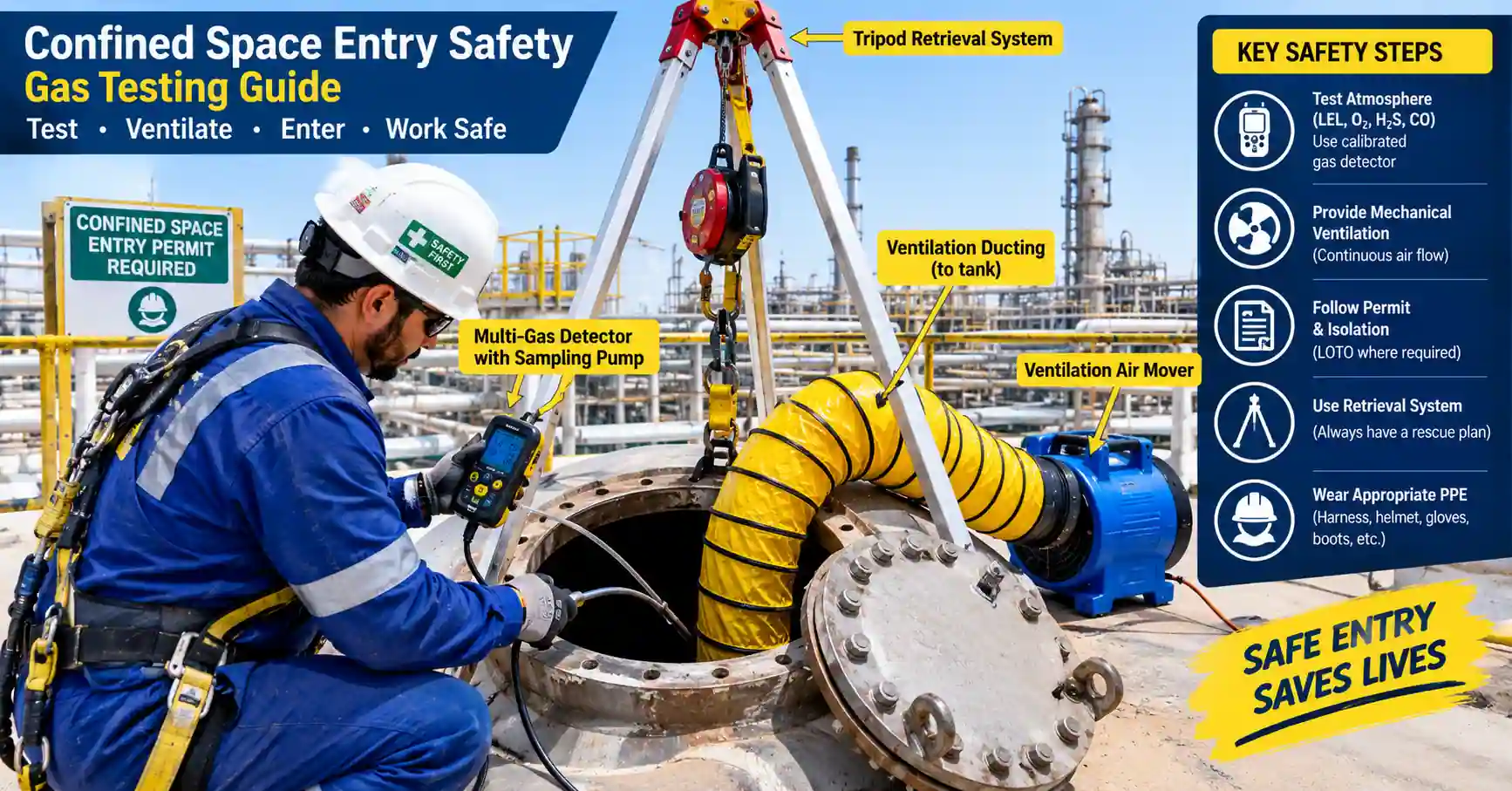
- Continuous Mechanical Ventilation: Deploy pneumatic, explosion-proof air movers (e.g., Coppus blowers) grounded against static build-up. Airflow must deliver a minimum of 20 volumetric air changes per hour, directing fresh air to the bottom or stagnant pockets of the structure. Mechanical ventilation must run continuously throughout the work shift.
[Personal Field Experience: Confined Space Safety and Attendant Responsibilities
Based on my 10–12 years of hands-on experience in SABIC and Aramcorelated petrochemical, oil and gas facilities in Saudi Arabia, I understand that confined space safety requires competent personnel, effective monitoring, and strict compliance with site procedures.
Real Life Experience: During a turnaround involving a butadiene storage sphere at an affiliate complex in Jubail, secondary gas testing at multiple elevations identified an oxygen concentration of 16.5% near the upper baffle plate following nitrogen purging. This experience demonstrated why single-point gas testing is insufficient to verify the safety of an entire confined space. Testing must consider vessel configuration, internal obstructions, and potential atmospheric hazards.
Confined Space Attendant Responsibilities: The attendant must remain at the designated entry point while workers are inside and must not leave unless an authorized, competent replacement takes over according to site procedures. Responsibilities include maintaining an entry log with workers’ names, identification numbers, entry and exit times, and required signatures. The attendant must maintain communication, monitor personnel, prevent unauthorized entry, and immediately notify the designated Rescue Team or Emergency Response Team (RT/ERT) if an emergency occurs.
Rescue Preparedness: Appropriate rescue equipment, such as retrieval systems, harnesses, breathing apparatus, and communication devices, must be available according to the approved rescue plan. The attendant must never attempt an unauthorized rescue entry.
Gas Testing and Monitoring: Testing frequency depends on the client’s requirements, permit conditions, risk assessment, and work activity. Monitoring may be required before entry, at specified intervals, or continuously. Where necessary, gas testing must cover multiple elevations to identify oxygen deficiency, flammable gases, and toxic substances. If unsafe conditions develop, workers must evacuate according to site procedures.
My Safety Philosophy: Every confined space operation requires teamwork between the Permit Issuer, Permit Receiver, Attendant, Gas Tester, work crew, and emergency responders. Regular toolbox talks, verified isolation, effective ventilation, and clear emergency arrangements are essential.
In my experience, an alert attendant, competent workforce, and effective atmospheric monitoring are critical to preventing confined space incidents. Every worker must understand their responsibilities, recognize hazards, and stop work when conditions become unsafe. Our ultimate objective is to prevent injuries and achieve zero accidents through proper planning, vigilance, and compliance with approved safety procedures.]
Atmospheric Testing Sequence and Technical Exposure Limits
Atmospheric monitoring must be performed by a certified Gas Testing Technician (GTT) using a calibrated, intrinsically safe direct-reading multi-gas analyzer equipped with a motorized sampling pump and Teflon-lined sampling hose. Sampling must occur from outside the space prior to opening access manways, followed by stratified internal sampling at top, middle, and bottom sections.
Testing must strictly adhere to a three-step sequential procedure to eliminate false instrument indications:
- First Priority Oxygen (O2) Concentration: Oxygen level must measure between 19.5% and 23.5% by volume. Accurate oxygen concentration is mandatory because catalytic bead flammable gas sensors depend on atmospheric oxygen to oxidize target gases and yield accurate LEL readings.
- Second Priority Flammable Gases and Vapors (LEL): The concentration of flammable vapors must not exceed 0.0% LEL for hot work operations, and must remain below 10% LEL for cold work activities under standard operations. (SABIC SHEM-08 and Aramco GI 2.709 mandate 0% LEL for hot work without exception).
- Third Priority Toxic Contaminants (H2S and CO): Hydrogen Sulfide (H2S) concentrations must read 0.0 ppm (permissible threshold capped at 10 ppm with mandatory SCBA usage under specialized procedures). Carbon Monoxide (CO) must strictly remain under 25 ppm.
| Atmospheric Parameter | Standard Entry Threshold | Hot Work Maximum Limit | Action Required Outside Range |
|---|---|---|---|
| Oxygen (O2) | 19.5% to 23.5% | 19.5% to 23.5% | Evacuate, increase forced air ventilation, re-test |
| Combustible Gas (LEL) | < 10% LEL (Cold Work) | 0.0% LEL (Strict Limit) | Halt work, revoke permit, purge and re-clean vessel |
| Hydrogen Sulfide (H2S) | < 10 ppm (0.0 ppm target) | 0.0 ppm | Evacuate space immediately; don SCBA if rescue needed |
| Carbon Monoxide (CO) | < 25 ppm | < 25 ppm | Stop work, locate source, re-establish purging |
Technical Safety Highlight
Direct-reading gas testing instruments must undergo daily bump testing with a certified calibration gas mixture before field deployment. A bump test verifies sensor response and alarm activation. Full instrument calibration is required every 30 days or following any failed bump test.
Duties of the Confined Space Standby Person (Attendant)
The Standby Person occupies a pivotal station outside the entrance manway. Under Saudi Aramco GI 2.709 and SABIC SHEM-08 standards, the attendant has no secondary operational assignments that could distract from continuous monitoring. Key regulatory duties include:
- Maintaining an active Entrant Log noting exact names, badge numbers, entry times, and exit times.
- Maintaining continuous two-way visual or voice communication with all internal entrants.
- Monitoring external hazards (e.g., adjacent vent stack releases, heavy equipment exhaust near air blowers).
- Ordering immediate space evacuation if internal atmospheric alarms trigger, behavioral distress is observed, or external plant emergencies arise.
- Initiating non-entry emergency retrieval protocols (winch/tripod) and calling plant emergency dispatch upon detecting entrant collapse. Under no circumstances may the standby person enter the space.
Scenario Based WPR Examination Practice MCQs
Test your knowledge with these scenario-based questions encountered during Saudi Aramco and SABIC Work Permit Receiver certification assessments:
Q1: A Work Permit Receiver is preparing a fuel oil storage tank for internal inspection. Initial gas testing outside the manway reads O2: 20.9%, LEL: 4%, H2S: 0 ppm. What is the correct permit issuance decision for cold work entry?
- A) Issue the Confined Space Entry permit immediately because LEL is below 10%.
- B) Issue both Cold Work and Hot Work permits simultaneously.
- C) Authorize entry provided entrants wear air-purifying half-mask respirators.
- D) Reject permit issuance; order further flushing and mechanical ventilation until LEL drops closer to 0%.
Correct Answer: A
Engineering Rationale: For cold work entry within a permit-required confined space, an LEL reading under 10% combined with normal oxygen levels (20.9%) is legally permissible under general instruction guidelines, provided continuous ventilation is maintained. (Note: Hot work requires strictly 0% LEL).
Q2: During hot work cutting inside a pipe spool compartment, the continuous multi-gas monitor triggers a low-level Oxygen alarm reading 18.8% O2. What immediate action must the Work Permit Receiver mandate?
- A) Increase fresh air blower pressure and allow work to continue for 10 minutes.
- B) Instruct the welder to don a dust mask and finish the cut.
- C) Immediately order all workers out of the space, cancel the permit, and investigate the source of oxygen displacement.
- D) Switch the cutting torch to pure oxygen gas line to boost ambient oxygen.
Correct Answer: C
Engineering Rationale: Oxygen concentration below 19.5% constitutes an oxygen deficient atmosphere under GI 2.709 and OSHA criteria. Work must stop instantly, personnel must evacuate, and permits must be revoked pending engineering resolution.
Essential Industrial Safety Resources
Advance your professional field knowledge by referencing our full array of technical loss prevention guides:
- Examine the comprehensive certification roadmap in our Saudi Aramco WPR Exam 2026 Guide.
- Review mandatory energy isolation practices via our guide on Lockout/Tagout (LOTO) Procedures for Industrial Work Permit Receivers.
What is the legal atmospheric definition of an oxygen-deficient space?
An oxygen-deficient atmosphere is defined as any air mixture containing less than 19.5% oxygen by volume. Exposure leads to impaired judgment, fatigue, unconsciousness, and rapid asphyxiation. Entry without SCBA or continuous forced ventilation is strictly prohibited under Saudi Aramco and SABIC regulations.
Why must atmospheric testing precede mechanical manway removal?
Atmospheric testing through small sampling ports or bleed valves prior to breaking manway seals prevents exposing field technicians to sudden releases of pressurized, highly toxic (H2S), or explosive gas clouds accumulating behind closed flanges.
Can a Standby Person leave their post if all entrants temporarily pause work?
No. The Standby Person must remain stationed at the manway as long as the permit remains active or until explicitly relieved by another qualified attendant. If all entrants exit the space, the attendant must block physical re-entry before stepping away.
What is the primary difference between a bump test and full instrument calibration?
A bump test is a qualitative check exposing gas sensors to target gases to confirm sensor response and alarm functionality daily. Full calibration is a quantitative adjustment using traceable standard gas mixtures to ensure reading precision across sensor ranges.
Author Engineering Credentials & Technical Governance
Lead Author: Senior Technical Safety Engineer & Industrial Loss Prevention Consultant holding over 15 years of operational expertise in oil, gas, and petrochemical complexes across Eastern Province, Saudi Arabia (Saudi Aramco facilities, SABIC Petrokemya, Hadeed, Sharq, Arrazi, Safco, Yansib, Petrorabic and Yanpet etc.
Governing Industrial Standards & Codes Referenced:
- Saudi Aramco General Instruction GI 2.709 (Gas Testing Procedure and Confined Space Entry Requirements)
- Saudi Aramco General Instruction GI 2.100 (Work Permit System Compliance)
- SABIC Environment, Health, Safety, and Security Standard SHEM-08 (Confined Space Entry Safety)
- US OSHA 29 CFR 1910.146 (Permit-Required Confined Spaces for General Industry)
- National Fire Protection Association NFPA 350 (Guide for Safe Confined Space Entry and Work)