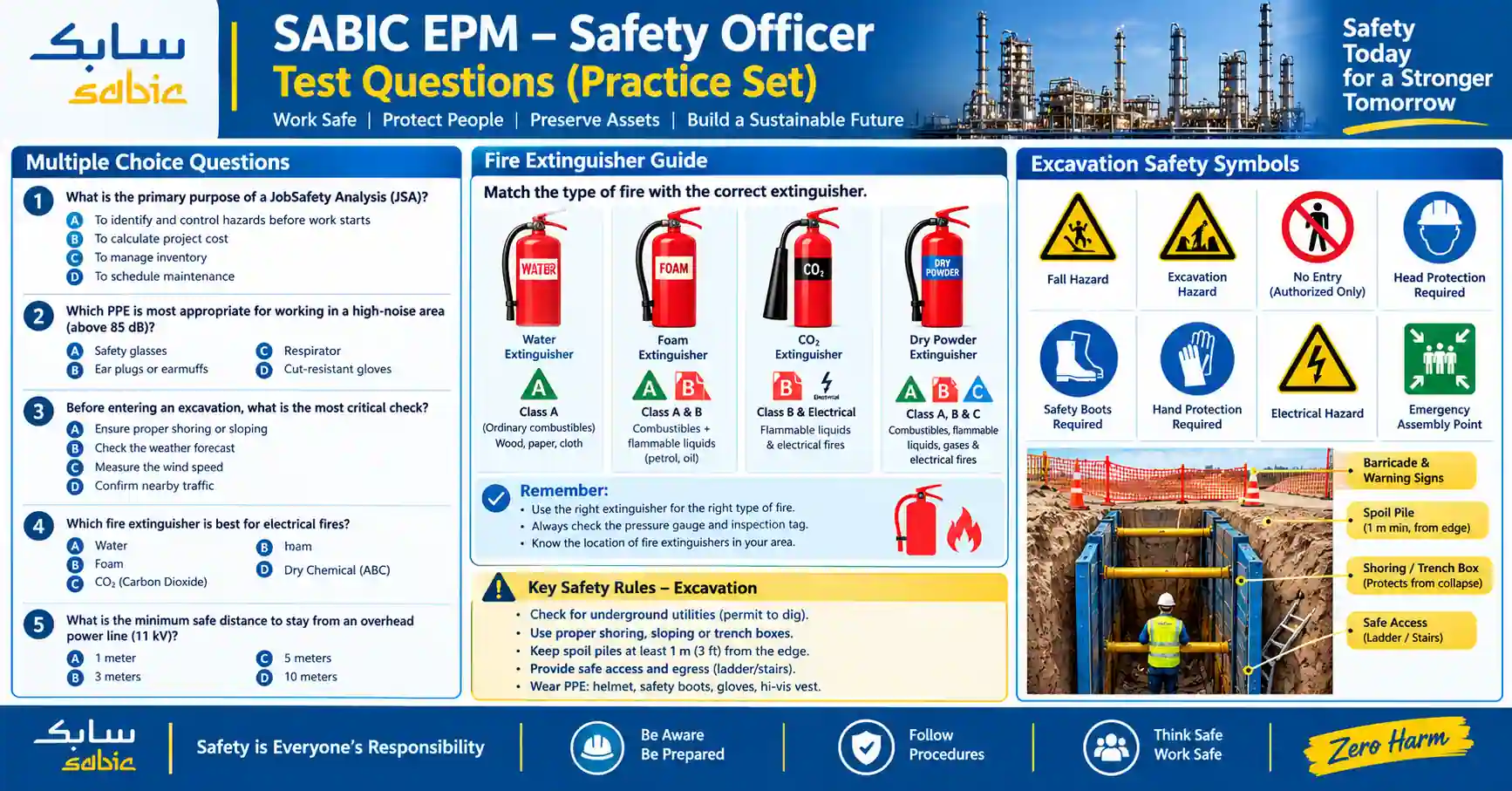
SABIC EPM Safety Officer Exam Questions & Answers 2026
Quick Executive Summary
Preparing for the SABIC EPM (Enterprise Protection Management) Safety Officer Examination requires absolute proficiency in excavation safety, Life-Saving Rules (LSR), hazard identification, and work permit protocols. This comprehensive study guide incorporates authentic test questions directly from SABIC affiliate pre-qualification test papers with clear step-by-step multiple-choice options and bolded correct answers for fast revision.
Join Our VIP Saudi Industrial Safety & WPR Exam Preparation Network!
Get real exam scenarios, updated guidelines, and daily safety job notifications directly on WhatsApp & Telegram.
Introduction to SABIC EPM Safety Officer Exam and Certification
Saudi Basic Industries Corporation (SABIC) maintains exceptionally high standards for Environmental Health, Safety, and Security (EHSS) across all manufacturing affiliates, including Petrokemya, Hadeed, Sharq, Arrazi, and Yanpet. Safety Officers and Work Permit Receivers (WPR) seeking authorization under the SABIC Engineering & Project Management (EPM) framework must pass a comprehensive pre-qualification safety assessment. This article compiles authentic examination questions, technical definitions, fill-in-the-blank specifications, and multiple-choice questions extracted directly from official questionnaires to ensure complete preparation.
Key Exam Focus Highlights
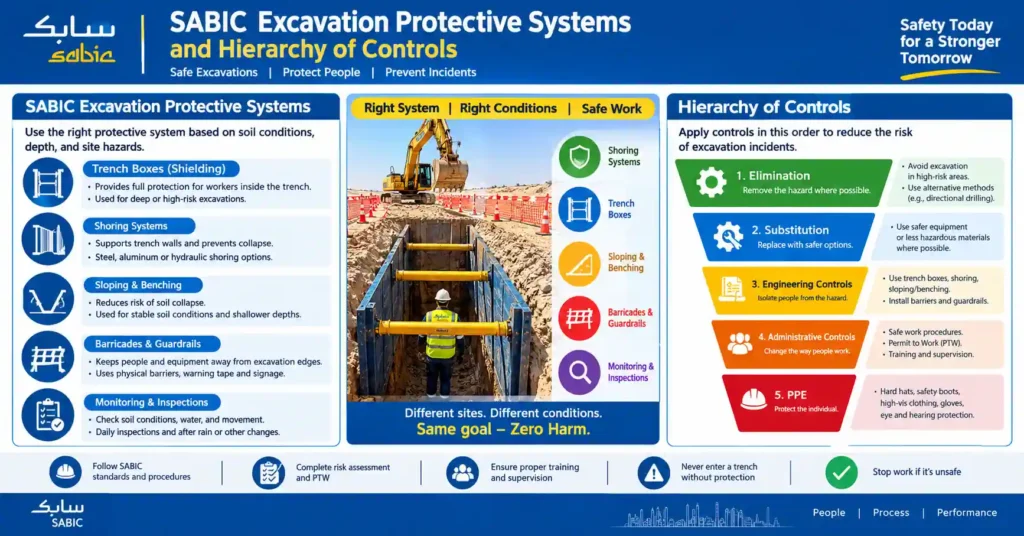
- Excavation Protective Systems: Shoring, Sloping, and Benching mechanisms.
- Hierarchy of Control: Order of hazard controls from Elimination to PPE.
- SABIC Work Permits: Cold Work, Hot Work, Confined Space, Electrical, and Radiation Permits.
- Safety Calculations: Ladder extension lengths, scaffold engineering thresholds, and fire extinguisher ratings.
1. Essential Safety Definitions (Test I Review)
The following terminology forms the foundational definition section in the SABIC Safety Officer pre-qualification test papers:
- Risk: The combination of the likelihood of the occurrence of a hazardous event and the severity of injury or damage to health caused by the event.
- Confined Space: A space that is not designed for continuous human occupancy and has limited access and egress.
- Scaffolding: A temporary elevated platform used to support personnel, materials, and machinery at height.
- Hot Work: Any activity that produces sources of ignition or heat, such as spark generation, grinding, welding, and brazing.
- Near Miss: An undesirable event that has the potential to cause loss or injury.
2. Core Safety Protocols and Procedural Workflows (Test IV Review)
Candidates must write structured lists for core hazard management systems during the written assessment:
What are the 3 basic protective systems used in excavation and trenches?
- Shoring
- Sloping
- Benching
List at least 5 SABIC Life-Saving Rules (LSR):
- Safe Work Procedure
- Confined Space Entry
- Working at Height
- Line Break
- Disable Safety System
List all SABIC Work Permit Categories:
- Cold Work Permit
- Hot Work Permit
- Confined Space Permit
- Electrical Permit
- Radiation Permit
Outline the Hierarchy of Control for Hazards (In Descending Order):
- Elimination
- Substitution
- Engineering Control
- Administrative Control
- PPE (Personal Protective Equipment)
List requirements to protect workers when working at height to prevent falls:
- Full Body Harness
- Guard rail system
- Life Line
- Safety net
- Training & Inspection
Outline non-atmospheric hazards in confined spaces:
- Illumination
- Communication
- Falling hazard
- Electrical hazard
- Engulfment hazard
3. Technical Safety Specifications and Parameter Reference Table
| Safety Parameter | Standard Requirement / Threshold | Governing Standard |
|---|---|---|
| Ladder Landing Extension | Must extend at least 3 feet (90 cm) above landing | SABIC / OSHA Safety |
| Gas Re-test Max Interval | Maximum re-test frequency is 30 minutes if unlisted | SABIC Gas Rules |
| Scaffold Design Approval Height | Structures over 42 meters require engineer review | Scaffold Safety Code |
| Hot Work Movable Hazard Clearance | Moved at least 15 meters away from work area | Hot Work Safety |
4. Official SABIC EPM Multiple-Choice Questions (Test II Review)
Below are the exact multiple-choice questions from the official SABIC EPM questionnaire with clear options and highlighted correct answers:
Q1: How many meters that scaffolding structure required a designs, reviewed and approved by qualified engineer?
- a. Over 37 meters
- b. Over 25 meters
- c. Over 50 meter
- d. Over 42 Meters
Q2: Which type of fire extinguisher can use for electrical?
- a. Water
- b. Foam
- c. CO2
- d. A&B
Q3: How many decibel it may require to wear double hearing protection, i.e. both earplugs and earmuffs are required.
- a. 85 dB (A)
- b. 90 dB
- c. 170 dB
- d. 110 dB
Q4: The base of a ladder whose top support is 16 feet high should be how far from the wall.
- a. 5 ft.
- b. 3 ft.
- c. 6 ft.
- d. 4 ft.
Q5: In case of storm or high wind speed, how many miles per hour/km/hr that the scaffolding structure not be used/constructed/erected
- a. 40 miles per hour (65 km/hr)
- b. 30 miles per hour (48 km/hr)
- c. 25 miles per hour (40.2 km/hr)
- d. None of the above
Q6: How many hours that hot work permit become suspended / cancelled if work does interrupted or not started.
- a. 4hrs
- b. 2hrs
- c. 8hrs
- d. 12hrs
Q7: A fire involving flammable liquids is classified as which type of fire
- a. Class A
- b. Class B
- c. Class D
- d. Class K
Q8: You have spray painting activity in a confined space. Why do you have to ventilate the space?
- a. In order to remain below the lower explosion limit (LEL)
- b. In order to remain below 10% of the lower explosion limit (LEL)
- c. In order to below 20% of the lower explosion limit (LEL)
- d. None of the above
Q9: An extinguisher with a D rating is design for use on which type of fire.
- a. A fire involving flammable liquids
- c. A fire involving combustible metals
- d. A fire involving ordinary combustible materials
- e. A fire involving energized electrical equipment
Q10: Why insulation used of electrical conductors?
- a. To limit the consequences of a short circuit
- b. To prevent contact with live parts
- c. To prevent damage
- d. To prevent heat
Q11: The four simple steps for operating a fire extinguisher can be remember with the word PASS. Pull Activate Squeeze Sweep
- a. True
- b. False
Q12: What will happen if you paint the wooden scaffold planks?
- a. Workers are more likely to slip on the planks
- b. You won’t be able to see any cracks or defects in the wood
- c. The wood will probably last longer and it good looks.
- d. You can easily identify the materials in the workplace.
Q13: Installation of Lock out and Tag-out (LOTO)-The equipment owner department lock and tag shall be installed first and removed last.
- a. True
- b. False
Q14: For hot work activity how many meters is required that all moveable fire hazards in the vicinity shall be moved at least
- a. 3 meters
- b. 9 meters
- c. 15 meters
- d. 30 meters
Q15: How many kilogram of an object required two or more employees to lift/handle.
- a. 23kg
- b. 20kg
- c. 25kg
- d. None
Q16: For gas testing of confined spaces, it is to be done within half of the re-test frequency recommended in the permit or if re-test frequency is not mentioned then the maximum time for re-test is 30 minutes
- a. True
- b. False
Q17: Permits shall be canceled under any of the following conditions
- a. If the conditions on the permit are not complied with
- b. Failure to commence work within one hour of being issued, or if there is an interruption of work
- c. Tags shall not deteriorate when used in corrosive environments such as areas where acid and alkali chemicals are handled and stored
- d. A, B & C
Q18: Process pipelines should not be used as far as practicably possible. If it is unavoidable and pipe line has to be used its diameter should be at least _____ or larger.
- a. 2 inch
- b. 2.5 inch
- c. 3 inch
- d. 4 inch
Q19: Chemical splash goggles shall meet the applicable local/regional/international standards/regulations requirements, otherwise it shall be mandatory in accordance with latest version of
- a. ANSI Z87.1
- b. ANSI Z41
- c. EN 388
- d. None
Q20: Compressed gas shall never be used from cylinders without reducing the pressure through a suitable regulator attached to the cylinder valve or manifold.
- a. True
- b. False
(My Personal Experience as a SABIC and Saudi Aramco Safety Officer)
[ I would like to share my personal experience and some practical guidance with everyone who wants to build a career as a Safety Officer in Saudi Arabia.
I have around 15 years of experience in the safety field, working in SABIC and Saudi Aramco environments, and I am personally EPM and PMT Approved. Throughout my career, I have gained practical experience with industrial safety requirements, permit-to-work systems, risk assessments, gas testing, PPE compliance, and other essential safety procedures.
During my experience at different industrial plants and projects, I learned that safety requirements can vary depending on the plant, type of work, site conditions, and client procedures. For example, during an EPM safety audit at Jubail Industrial Complex, verifying gas-testing retest intervals and ensuring that compressed gas regulators were properly connected were important compliance checks. These requirements are not just paperwork; they help prevent serious incidents and protect workers, equipment, and plant operations.
About the SABIC EPM Safety Officer Test
The SABIC EPM Safety Officer practice questions I am sharing are based on the actual assessment questions I encountered and my practical experience with the approval process. They are intended to help candidates understand the types of safety topics they may face during their preparation.
I will also share PMT-related exam preparation material soon to help candidates prepare for their assessments.
My aim is to share practical knowledge that can help fresh candidates and experienced safety professionals improve their understanding of industrial safety requirements.
How to Build a Successful Career as a Safety Officer
Safety is a responsible profession, and it can offer good career opportunities for candidates with the right qualifications, communication skills, and practical knowledge. However, certificates alone are not enough. You must also understand how to apply safety procedures in real working conditions.
If you want to pursue a career as a Safety Officer in Saudi Arabia, I recommend focusing on the following areas:
Professional certifications: Work towards relevant qualifications such as NEBOSH, IOSH, and OSHA courses, depending on the requirements of your target position.
English communication: Improve your spoken and written English because safety instructions, permits, toolbox talks, and incident reports often require clear communication.
Safety vocabulary: Learn technical terms related to industrial operations, hazards, risk assessments, PPE, emergency response, and permit-to-work systems.
Practical knowledge: Study Job Safety Analysis (JSA), Risk Assessment (RA), Method Statements, gas testing, Lockout/Tagout (LOTO), and other relevant safety documents.
Plant specific requirements: Understand that every plant and client may have different procedures, checklists, and supporting documents. Always follow the applicable site requirements.
What Does a Safety Officer Actually Do on Site?
A Safety Officer’s responsibility goes far beyond checking workers’ helmets or completing paperwork. The role requires continuous attention, good communication, and the ability to identify hazards before they lead to an incident.
On site, a Safety Officer is generally responsible for:
1. Conducting Toolbox Talks (TBTs) before work begins.
2. Identifying unsafe acts and unsafe conditions and taking appropriate action to correct them.
3. Ensuring that workers understand the hazards associated with their tasks.
4. Checking that the required PPE is available, suitable, and being used correctly.
5. Verifying that permits to work, risk assessments, and other required safety documents are in place.
6. Monitoring gas-testing requirements and ensuring that the required retesting is carried out according to site procedures.
7. Inspecting work areas, equipment, access routes, scaffolding, and excavations where applicable.
8. Reporting accidents, near misses, and unsafe conditions promptly.
9. Coordinating with supervisors, permit issuers, permit receivers, and other site personnel to maintain safe working conditions.
10. Promoting professional behaviour, teamwork, and a positive safety culture.
Remember, a good Safety Officer does not simply point out mistakes. A good Safety Officer explains the risk, communicates respectfully, and helps the team find a safe way to complete the job.
My Advice to Future Safety Officers
If you are serious about entering the safety profession, start preparing today. Improve your qualifications, practise English every day, build your technical vocabulary, and learn from people with genuine field experience.
Do not focus only on passing an examination or obtaining an approval. Focus on becoming a competent Safety Officer who understands hazards, makes responsible decisions, and can protect people in real working environments.
My goal is to share what I have learned through my experience in SABIC and Saudi Aramco environments so that others can prepare better and develop their careers in the safety field.
Safety is not just a job title. It is a responsibility to protect lives, prevent incidents, and make sure every worker returns home safely. ]
5. Subjective & Descriptive Questions (Test III Review)
Review these detailed technical responses for the written subjective portion of the assessment:
1. Describe the difference between fall prevention and fall protection.
Answer: Fall prevention includes proactive measures designed to eliminate fall hazards completely, such as guardrail systems and barricades. Fall protection involves systems engineered to safely arrest a worker in the event of a fall, such as Full Body Harnesses (FBH) and safety nets.
2. Explain the purpose of a rescue plan.
Answer: A rescue plan supports risk assessment planning by providing a structured, safe method to retrieve workers in emergencies and minimize injuries during confined space or high-altitude rescue operations.
3. What are the main objectives why employees sign in the work permit?
Answer: When workers sign the permit, it confirms that they understand the job hazards, have reviewed safety procedures, and are trained and qualified for the assigned task.
4. Difference of Toxic and Corrosive chemical.
Answer: Toxic substances are poisonous to living organisms and can cause injury, illness, or death when inhaled, ingested, or absorbed through the skin. Corrosive substances are capable of damaging or destroying other materials—especially metals—through chemical reaction.
5. Explain the main reason why health and safety policy must be signed by the most senior person in the organization?
Answer: Signing the health and safety policy demonstrates management’s commitment, showing that the organization is serious and agreed to implement safety rules and regulations at the workplace.
6. Visual Hazard Recognition and Safety Pictograms (Test V Review)
Candidates must successfully identify NFPA Fire Diamonds, Chemical Hazard Pictograms, and Fire Extinguisher components during practical evaluations:
- Fire Diamond (NFPA 704): Blue quadrant represents Health hazard, Red represents Flammability, Yellow represents Instability/Reactivity, and White indicates Special hazards.
- Fire Extinguisher Components: Key components include the Safety Pin, Pressure Gauge, Operating Handle, Discharge Hose, and Inspection Seal Tag.
- Gas Storage Safety: Gas cylinders must be stored at a minimum distance of 15 meters from flammable or combustible materials.
7. Related Safety Resources
Further enhance your safety knowledge with these industrial guides:
Frequently Asked Questions (FAQs)
1. What are the three basic protective systems used in excavations under SABIC rules?
The three basic protective systems are shoring, sloping, and benching.
2. What is the maximum atmospheric re-test interval for confined spaces if unlisted on the permit?
If not specified on the permit, atmospheric re-testing must occur within 30 minutes.
3. What fire extinguisher type is suitable for electrical fires?
CO2 fire extinguishers are approved for fires involving energized electrical equipment.
4. What weight limit requires two or more employees to lift or handle an object?
Objects weighing 25kg require team lifting and handling.